Retail Screens Work Best When They Improve the Store
Screen-enhanced retail is not about covering a store with digital noise. It is about using screens to make physical shopping more useful, expressive, and responsive. A good display can explain a product story, show a colorway that is not on the floor, support a staff recommendation, guide a shopper through a category, or turn a blank wall into a seasonal campaign without permanent construction. The store still matters because customers can touch, compare, try, ask, and feel. Screens become valuable when they strengthen those advantages instead of trying to replace them.
Physical Retail Needs a Clearer Reason to Exist
Customers no longer visit stores only because stores have inventory. They can research, compare, and buy from a phone. Physical retail has to offer something richer: confidence, discovery, touch, service, immediacy, and a sense of occasion. Screens can help deliver that richer experience when they connect digital depth to physical presence.
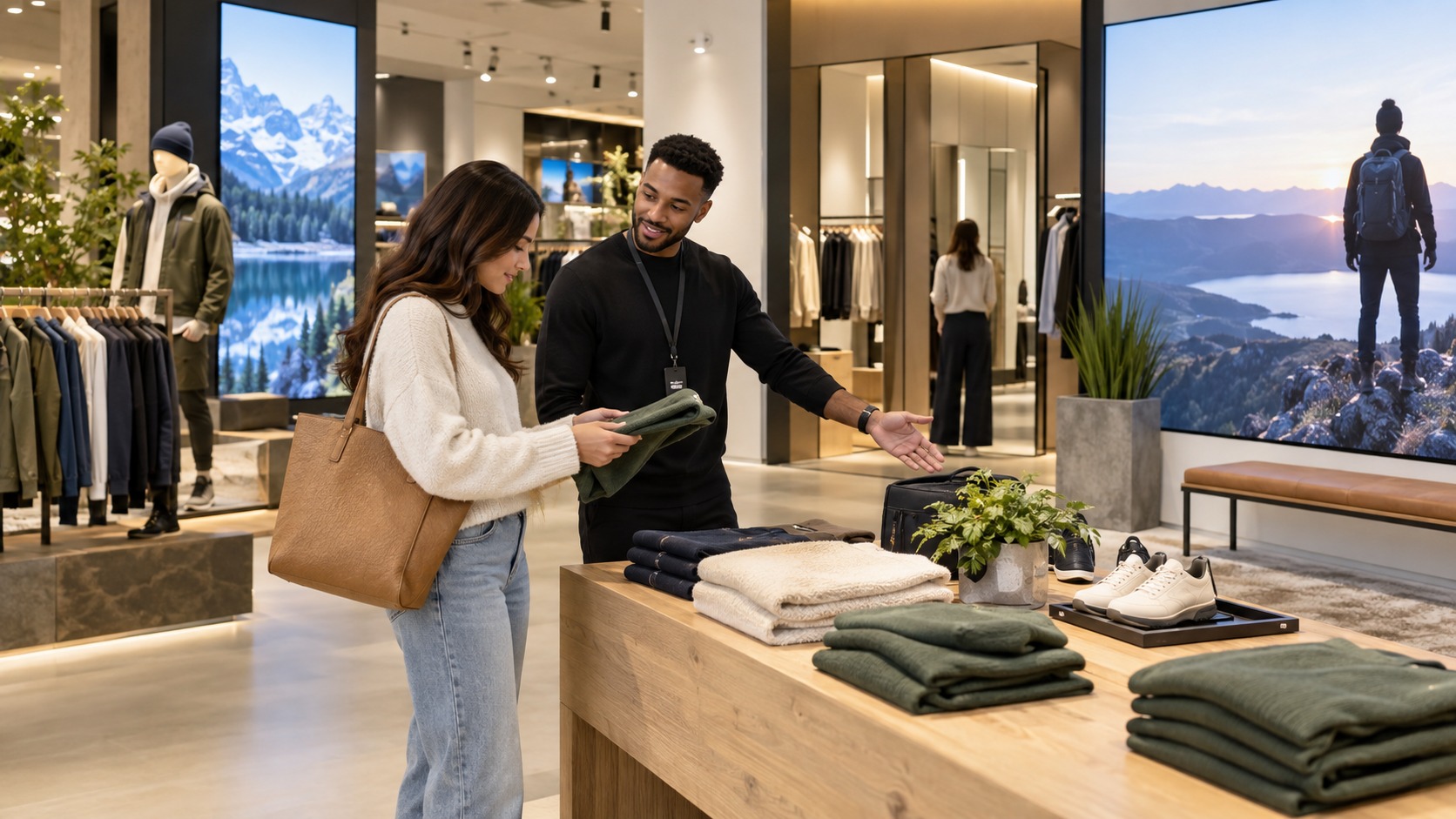
A screen can show how a jacket moves outdoors while the actual jacket hangs nearby. It can show a sofa in multiple rooms while the fabric swatch is in the customer's hand. It can explain a skincare routine while products remain organized on the shelf. The screen adds context, but the store gives that context weight.
The Store Becomes More Adaptive
Traditional merchandising is powerful but slow. Fixtures, printed signs, window props, and wall graphics take time to produce and install. Screen-enhanced retail lets stores adjust faster to weather, inventory, season, events, and local demand. A rainy weekend can shift outerwear messaging. A launch can take over a feature wall. A low-stock product can be removed from promotion before it disappoints shoppers.
This flexibility is especially useful for chains with local variation. Stores do not need to look identical to feel coherent. Digital content can adapt to neighborhood behavior while keeping the brand language intact.
Screens Should Support the Merchandise Hierarchy
The biggest risk in screen-enhanced retail is visual competition. If the display is brighter, faster, and louder than the product, the store becomes a media room with merchandise scattered around it. Successful retailers define hierarchy carefully. Sometimes the screen is the hero. Sometimes it is a quiet supporting surface. Sometimes it should disappear until a customer needs help.
Placement is part of that hierarchy. A campaign wall can sit at the store entrance because it sets the story. A comparison screen belongs near the products being compared. A service screen belongs where customers make service decisions. When screens are placed only where power is convenient, they rarely feel strategic.
Retail teams should walk the store from a shopper's point of view. What does the customer see first? Where do they slow down? Where are they confused? Those answers should drive screen placement.
Interactive Features Need a Real Purpose
Touchscreens, mirrors, tablets, and triggered displays can be useful, but interactivity should not be added just because it is available. Every interactive moment asks the customer to do work. That work must be rewarded with better information, better fit, better service, or a stronger sense of control.
A fitting-room screen that requests another size can be genuinely helpful. A product configurator can be valuable for furniture, electronics, or custom goods. A screen that asks shoppers to tap through shallow promotional slides may create friction instead of engagement.
Associates Are the Bridge
Store teams determine whether screens feel alive or ignored. When associates understand the content, they can refer to it naturally: showing a material story, comparing use cases, or pulling up an alternate color. When they are not trained, screens become background decoration that customers may or may not notice.
The best rollouts include staff enablement. Associates should know what each display is for, when to point to it, how to recover if it fails, and what customer questions it is meant to reduce. Their feedback should also shape future content because they hear confusion before analytics can explain it.
Avoid the Endless Loop Problem
Many retail displays fail because they loop brand videos that no one needs after the first glance. Beautiful content can still become invisible if it never changes, never responds, and never connects to the products around it. Customers are skilled at filtering out screens that behave like background advertising.
Useful retail content has a job. It compares, explains, inspires, localizes, or reassures. It can still be visually polished, but polish is not the point. The shopper should leave the screen with a clearer reason to touch, try, ask, or buy.
The New Engagement Is Hybrid
Screen-enhanced retail points toward a hybrid store where digital and physical experiences stop competing. The customer may discover online, compare in store, scan for more detail, talk to an associate, try the product, and purchase through whichever channel is easiest. Screens help the store participate in that journey without pretending the phone does not exist.
The future store will not be the one with the most screens. It will be the one where every screen makes the shopping experience more grounded, more informed, and more worth leaving the house for.
Digital Storytelling Should Lead Back to Touch
Retail screens are strongest when they make the customer want to interact with the physical store. A product film should lead to touching the fabric, trying the fit, comparing the finish, or asking an associate a better question. If the customer only watches and walks away, the content may have entertained without engaging. The screen's job is to build a bridge from attention to action.
This is especially important in categories where the product has hidden value. Materials, construction, sustainability choices, performance features, care routines, or design heritage may not be obvious from the shelf. A display can reveal those details, but the nearby merchandise must be ready for the customer to inspect. When the story and product are separated, engagement breaks.
Merchandising Teams Need Faster Feedback Loops
Screen-enhanced retail gives merchandising teams a chance to learn faster. If a display story increases questions but not try-ons, the content may be interesting but poorly connected to product selection. If shoppers pause at a comparison screen and then choose one fixture more often, the store has learned something about decision confidence. If associates ignore a screen, the content may not match real conversations.
The feedback should combine observation, staff input, and sales data. Screens can produce analytics, but numbers alone rarely explain why a shopper hesitated or why a story resonated. Associates can report which claims customers repeat, which visuals start conversations, and which screens become invisible. That human feedback keeps digital retail grounded in real behavior.
The Store Window Becomes a Living Threshold
Windows have always been a store's public invitation. Screens make that invitation more flexible, but also more delicate. A digital window can shift from morning freshness to evening drama, announce a launch, respond to weather, or show movement that printed graphics cannot. It can also become too bright, too generic, or too disconnected from what shoppers find inside.
The window should create a promise the store can keep. If the screen shows adventure, the floor should help shoppers find the gear. If it shows elegance, the service and layout should support that mood. If it promotes convenience, pickup and checkout should feel convenient. Digital window storytelling works when crossing the threshold confirms the story rather than deflating it.
Screen Strategy Should Respect Different Shopping Speeds
Not every customer shops at the same speed. Some want inspiration and are happy to wander. Others want one item and a quick answer. Some need reassurance before a higher-priced purchase. Others are browsing socially. Screen-enhanced retail should support those different speeds rather than forcing everyone through one digital journey.
Fast shoppers need clear wayfinding, availability, and comparison cues. Exploratory shoppers may enjoy richer stories, styling suggestions, or seasonal scenes. High-consideration shoppers need evidence and staff support. A thoughtful store uses screens to create layers: glanceable information first, deeper content nearby, and human help when the decision becomes personal.
Engagement Should Create a Better Memory of the Visit
Retail engagement is sometimes reduced to dwell time, taps, scans, and impressions. Those metrics can help, but they do not fully capture whether a customer had a better store experience. A shopper may spend more time because they are confused. They may tap a screen because no associate is available. They may watch a video and still feel no closer to a decision. The deeper goal is a better memory of the visit.
A strong screen-enhanced store gives customers something they can carry forward. They understand why a material costs more. They discover a use case they had not considered. They see how a product fits into a lifestyle without losing the ability to touch and compare it. They receive help from an associate who has better tools at hand. That kind of engagement can influence the purchase, but it also influences whether the customer wants to return.
Retailers should therefore design screens around meaningful moments rather than raw exposure. The moment a customer enters, the moment they compare, the moment they try, the moment they hesitate, and the moment they seek reassurance all require different content. A single loop cannot serve them all. A thoughtful screen system gives each moment enough support without overwhelming the store.
The new age of customer engagement is not digital for its own sake. It is physical retail becoming more articulate. Screens help the store explain itself, adapt faster, and invite customers into a richer conversation with the products in front of them.
A Strong Rollout Has Fewer Moving Parts Than Expected
Retailers do not need to launch every screen feature at once. A disciplined rollout may begin with one campaign surface, one product education zone, and one associate tool. That is enough to test whether content, merchandise, and staff conversation are working together. Expanding too quickly can create a maintenance burden before the retailer understands what customers actually use.
A focused rollout also makes training more realistic. Associates can learn the purpose of each display and practice how to bring it into conversation. Merchandising teams can watch whether shoppers move from screen to product. Store leaders can identify who owns content updates. Once those habits are strong, the screen system can grow without becoming a scattered collection of digital fixtures.
Physical Comfort Still Decides Whether People Stay
No amount of digital storytelling can overcome an uncomfortable store. If aisles are cramped, screens glare into mirrors, seating is missing, or customers feel watched while browsing, engagement drops. The physical environment still determines whether shoppers slow down enough to benefit from enhanced content.
Retailers should therefore evaluate screens as part of the whole room. Where does a customer stand while watching? Are they blocking others? Can they touch the product immediately afterward? Does the screen create a comfortable pause or an awkward stop? The new age of engagement still depends on old-fashioned spatial courtesy.
When the room feels considerate, digital content has room to work because shoppers are not using their attention to manage discomfort.
TV Top 10 Product Reviews
Explore Philo Street’s TV Top 10 Product Reviews! Discover the top-rated TVs, access comprehensive reviews, and find the perfect screen for your space.