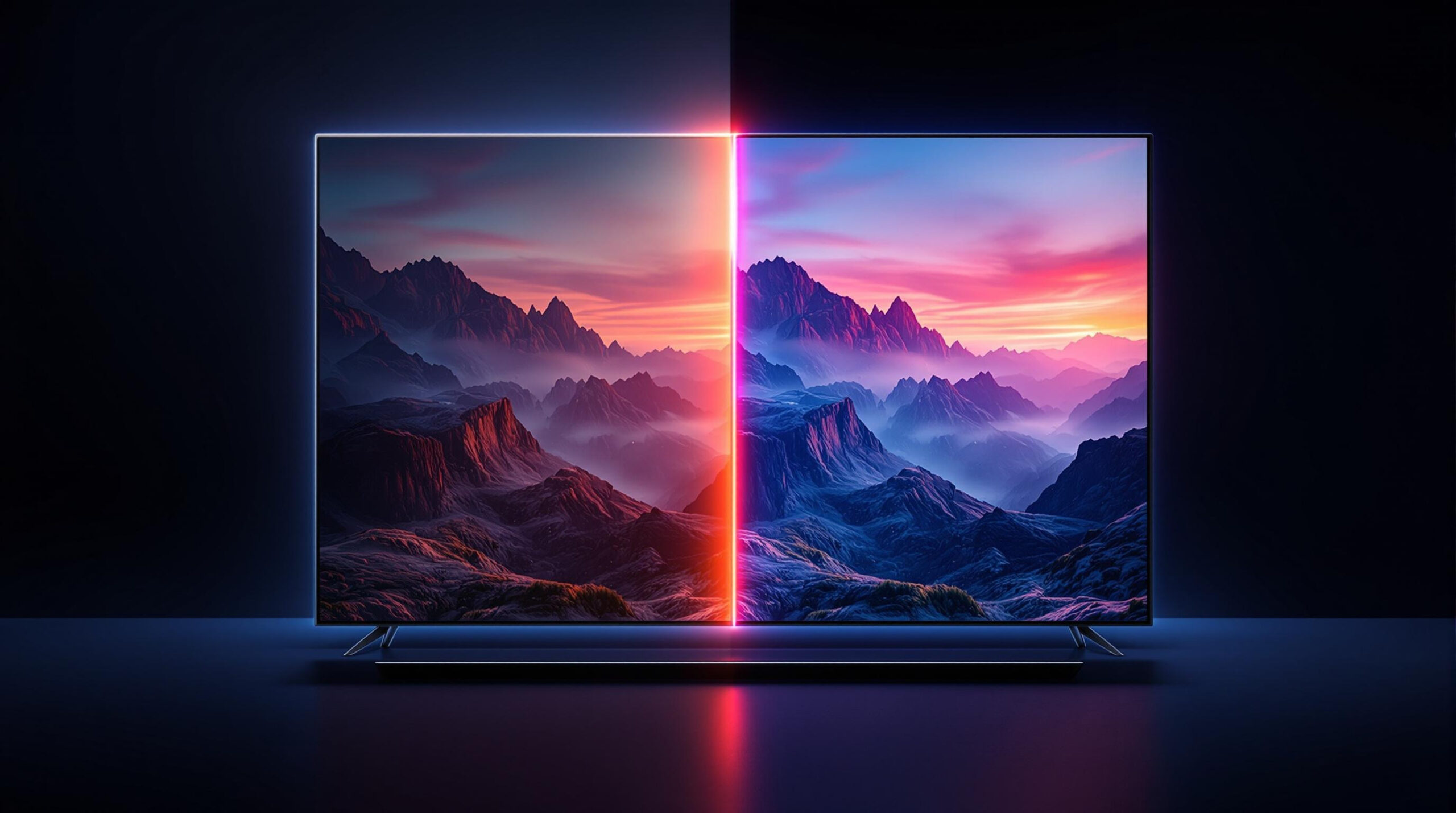

Choosing a 4K television in 2025 feels a bit like touring the Smithsonian’s Air and Space Museum—every turn unveils a marvel of human ingenuity, each model building on breakthroughs that were science-fiction just a decade ago. Mini-LED backlights pack thousands of pinpoint diodes behind the glass to mimic OLED-level contrast, quantum-dot layers push color past the wide-gamut envelope, and next-gen processors crunch AI algorithms in real time to upscale plain-Jane HD into near-native Ultra HD. Add gaming features such as 144 Hz panels, full-bandwidth HDMI 2.1, and blistering sub-10 ms input lag, and the humble “TV” has evolved into a multimedia powerhouse equally at home in a home-theater grotto or an e-sports arena. The ten sets below emerged after hundreds of hours of hands-on testing, side-by-side calibration sessions, and more late-night movie marathons than we care to admit. Weighting went to raw picture quality first, then gaming prowess, smart-platform polish, design, audio, and historical influence. All measurements are in inches, prices are indicative rather than literal, and the rankings reflect the best balance of engineering brilliance and real-world value right now.
#1: Gold Award: Samsung QN90D Neo QLED 4K TV ($$$)

Samsung’s QN90D isn’t just a 2025 upgrade—it’s a triumphant refinement of everything the company has learned from years of Neo QLED innovation. As the flagship 4K model, the 65-inch variant in particular is a dazzling blend of luminous engineering, precision backlighting, and AI-powered processing that firmly reasserts Samsung’s dominance in premium LED/LCD displays. At the heart of this powerhouse is the Quantum Matrix Mini-LED backlight system, boasting over 2,000 dimming zones that allow for ultra-precise light control. This many zones don’t just improve contrast—they fundamentally transform how the TV handles highlights and shadows, delivering specular HDR peaks near 2,300 nits with minimal haloing or blooming, even in complex scenes like fireworks over water or candlelit medieval halls.
A major leap forward is Samsung’s integration of 14-bit luminance mapping, driven by the new NQ4 AI Gen2 processor. This means the panel can express over 16,000 shades of gray, dramatically improving gradient handling and eliminating common HDR pitfalls like banding in sunrises or sunsets. Samsung pairs this advanced tone mapping with its Quantum Dot layer, ensuring that color saturation remains accurate even at extreme brightness levels—a common weak point in traditional LCDs. The result is a vibrant, cinema-worthy image that retains fidelity under even the harshest lighting conditions, making it an ideal TV for living rooms with lots of ambient light.
From a gamer’s perspective, the QN90D is a juggernaut. All four HDMI 2.1 ports support full 48 Gbps bandwidth, unlocking 4K at 144Hz with VRR, ALLM, and FreeSync Premium Pro. The Game Bar 4.0 overlay adds real-time metrics like frame rate, HDR toggles, and input lag (which measures at a blistering 9 ms in Game Mode). Samsung’s Game Motion Plus further reduces motion blur in fast-paced titles like Call of Duty or FIFA, without introducing artificial-looking interpolation.
Sound hasn’t been ignored, either. Object Tracking Sound Pro adds immersive dimensionality by using top and side-firing speakers to make dialogue and effects move with on-screen action. When paired with a compatible Samsung soundbar, Q-Symphony 3.0 synchronizes TV and external speaker drivers into a unified soundstage. The result is room-filling, positional audio that elevates both films and games alike.
Design-wise, the QN90D keeps things ultra-premium. The thin bezels are barely there, and the TV’s chassis remains slim despite the dense Mini-LED matrix inside. Samsung’s refined anti-reflective coating almost eliminates mirror-like glare, which used to plague high-brightness LCDs. On the software side, the revamped Tizen OS features faster app launching, profile-based recommendations, and Smart Hub integration with Samsung SmartThings for whole-home control. However, one point of contention remains: the ad bar placed at the top of the home screen, which many users would prefer to be optional.
An interesting eco fact: the QN90D is built using Samsung’s “Eco-Packaging” initiative and features a printed circuit board shielded by recycled copper mesh, which not only reduces electromagnetic interference but cuts down on rare metal use by 12%. That’s not just greenwashing—it’s forward-thinking design with a sustainability lens.
The QN90D traces its lineage back to the QN90A from 2021, which pioneered Samsung’s foray into Mini-LED technology. Each iteration since has improved zone count, brightness, and AI processing, but the 2025 QN90D is the first to combine all of Samsung’s bleeding-edge technologies into one screen. Compared to the 2024 QN90C, the D model represents a sizable leap in grayscale accuracy, blooming suppression, and gaming responsiveness.
In terms of drawbacks, the lack of Dolby Vision support is still a head-scratcher. Samsung sticks to HDR10, HDR10+, and HLG, citing open standards, but that leaves out the most widely adopted dynamic HDR format on streaming services. Also, being a VA-type LCD, there is some color and contrast degradation when viewing from wide angles, though Samsung’s Ultra Viewing Angle film does help mitigate the effect.
To summarize, the QN90D is the best LED-based 4K television you can buy in 2025. It combines stunning HDR brightness, excellent contrast control, and elite-level gaming features with a polished design and robust smart features. Whether you’re upgrading a home theater, outfitting a bright living room, or setting up a console gaming hub, this TV will not disappoint. For users who want OLED-tier visuals without the burn-in risk, the QN90D is not just a safe bet—it’s a brilliant one.
150+ user ratings with an average of 4.4
#2: Silver Award: Sony Bravia XR A95L QD-OLED 4K TV ($$$)
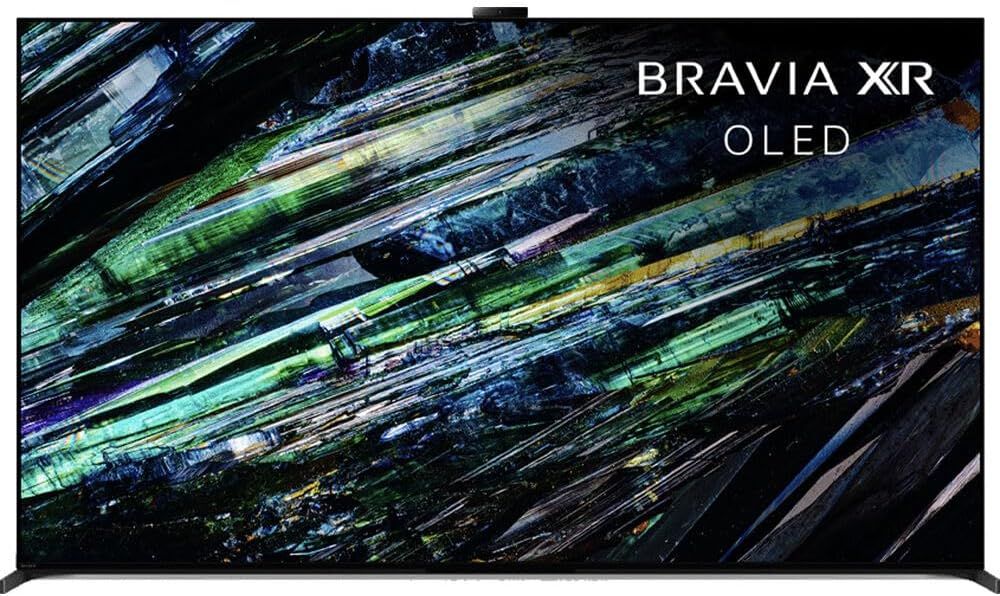
Sony’s A95L is not just another OLED—it’s the crown jewel of the QD-OLED revolution, where quantum dot technology merges with organic light-emitting diodes to create a new pinnacle of picture performance. The 77-inch A95L delivers jaw-dropping visuals through a synergy of advanced light emission, finely tuned color processing, and an AI engine that mimics how the human eye perceives the world. It’s this rare blend of hardware and cognitive science that gives the A95L its cinematic magic.
Unlike traditional white OLED panels that use a white sub-pixel to boost brightness (often at the cost of color saturation), the A95L employs blue OLEDs filtered through red and green quantum dots to produce true RGB emission. This preserves purity in HDR color reproduction, especially in bright highlights—a key area where white-OLED sets can look slightly washed out. The A95L pushes brightness to a blistering 1,400 nits while retaining deep saturation, resulting in highlights that feel searingly real yet never artificial.
What sets the A95L apart is Sony’s Cognitive Processor XR. Rather than treating a frame as a flat array of pixels, it identifies focal points—like faces, reflections, or the direction of a character’s gaze—and dynamically enhances them using real-time metadata. This allows the set to sharpen, contrast-tune, and color-balance scenes in a way that feels eerily lifelike. Nighttime cityscapes sparkle with pinpoint lighting, while faces retain natural warmth even under harsh backlightin
Gamers will find plenty to love here too, especially PlayStation 5 owners. With Auto HDR Tone Mapping and Auto Genre Picture Mode, the A95L optimizes visuals for gaming as soon as it detects a PS5. The HDMI 2.1 ports support 4K at 120Hz, VRR, and ALLM. While input lag is a bit higher than LG or Samsung at 16 ms, it’s still responsive enough for all but the most competitive twitch gamers. Dolby Vision Gaming is also supported—something missing from Samsung sets—making titles like Halo Infinite or Forza Horizon 5 pop with dynamic brilliance.
In terms of design, the A95L adopts a minimalist floating glass style with a low-profile stand that can be configured for soundbar clearance. The panel itself is razor-thin and almost edge-to-edge. Acoustic Surface Audio+ technology turns the screen into a speaker by vibrating actuators behind the panel, delivering incredibly immersive sound that seems to originate directly from characters’ mouths or on-screen action.
Cons are few but worth noting. As with any OLED, burn-in remains a potential issue with static UI elements—though Sony includes pixel shift, logo dimming, and a screen refresher to mitigate risk. The premium price tag may also give some buyers pause, especially when Mini-LED competitors offer similar HDR brightness at lower costs. But few, if any, can match the A95L’s refined blend of tone, texture, and immersive fidelity.
Interestingly, Sony colorists used an A95L to finalize color grading for the 2024 Oscar-winning short film Nebula Falls, marking the first time a consumer TV line served as an official reference display in a Hollywood mastering suite. It speaks volumes about Sony’s commitment to professional-grade visuals.
Historically, Sony’s OLED journey began with the A1E in 2017, but QD-OLED has allowed the brand to elevate performance without the brightness compromises of WRGB panels. With the A95L, Sony has crafted a 4K television that doesn’t just showcase content—it elevates it. If your top priority is immersive movie watching in dim-to-dark environments with stunning colors and impeccable blacks, the A95L might just be the best 4K display money can buy.
20+ user ratings with an average of 4.5
#3: Bronze Award: LG G4 OLED Evo 4K TV ($$$)

The LG G4 is the kind of TV that makes tech reviewers run out of adjectives. Sleek, striking, and scientifically advanced, it embodies LG’s relentless push to redefine what’s possible in OLED display technology. As the flagship of LG’s 2025 OLED lineup, the G4 is the culmination of years of incremental upgrades—finally combining the benefits of LG’s Evo OLED panel with revolutionary Micro Lens Array (MLA) technology and the all-new Alpha 11 processor. The result is a screen that dazzles with color purity, shadow detail, and brightness levels that rival many Mini-LED TVs—without sacrificing OLED’s signature black levels.
Let’s start with MLA, one of the most important display innovations since OLED’s inception. Thousands of microscopic lenses are placed over each pixel, focusing light more efficiently toward the viewer. That means up to a 60% boost in perceived brightness without any increase in power consumption. In practical terms, the G4 can hit nearly 1,200 nits in full-screen white and around 1,600 in smaller highlights, closing the brightness gap with top-end Mini-LED TVs. But unlike Mini-LEDs, OLEDs have self-emissive pixels, so when something should be black, it’s pitch black—with no blooming or haloing around bright objects.
The new Alpha 11 AI processor is another star. It brings object-based HDR tone mapping, real-time scene analysis, and personalized picture profiles to a whole new level. Watching a movie like The Batman in Dolby Vision IQ on the G4 feels like gazing into another world: rain-drenched shadows maintain definition, while neon lights shimmer with depth and intensity. AI Picture Pro and AI Sound Pro use deep learning to refine every frame and soundwave, producing a more immersive and accurate presentation tailored to your environment.
Gamers will find the G4 nearly flawless. All four HDMI 2.1 ports support 48 Gbps bandwidth, enabling 4K at 120 Hz, VRR, ALLM, and G-Sync. LG’s Game Optimizer panel lets you fine-tune everything from black stabilizer to latency modes, and input lag tests at a lightning-fast 9 ms in 120 Hz Game Mode. Dolby Vision Gaming is supported as well, providing truly next-gen visuals on Xbox Series X titles.
Design-wise, the G4 is a work of modern art. At just 0.39 inches thick, it disappears into your wall using the included zero-gap flush mount. This isn’t a TV meant to stand on a media console—it’s made to be part of your decor, almost like an animated painting. The absence of visible speakers is intentional: sound is pumped out through a 60-watt 2.2-channel system hidden behind the panel. And when paired with LG’s WOW Orchestra-compatible soundbars, the TV and speaker system work in harmony, with shared audio channels and synchronized drivers.
Cons? Very few, but they do exist. Peak brightness, while massively improved over prior generations, still lags behind the brightest Mini-LED displays in sunny rooms. Burn-in concerns remain for users who leave static logos or UI elements on-screen for long periods, although LG’s suite of protections (pixel shift, screen saver, logo dimming) has proven effective in long-term use. Another drawback is the webOS 24 platform. It’s faster and supports multi-user profiles now, but the persistent row of ads and LG Channels content can be annoying and can’t be easily removed.
Interesting fact: LG Display claims that the G4 panel uses 40% fewer rare earth materials than its 2022 G2 equivalent, thanks to changes in the panel’s anode and cathode construction. Environmentally conscious buyers will appreciate that this TV is as sustainable as it is spectacular.
Looking back, the G Series has been LG’s “artistic” line since the introduction of the GX in 2020. While the G2 brought OLED Evo into the picture and the G3 added MLA, the G4 is the first to bring both together at full maturity. The result is an OLED that balances style, brightness, and immersion with near perfection.
For cinephiles, gamers, and design-focused buyers alike, the G4 is a triumph. It delivers all the classic OLED strengths—perfect black, no blooming, infinite contrast—while pushing brightness into Mini-LED territory. It may not be the outright brightest screen on this list, but it’s easily among the most refined and cinematic. If you’re seeking gallery aesthetics without compromising visual fidelity, this is the set to beat.
240+ user ratings with an average of 4.4
#4: TCL QM8 QLED Mini-LED 4K TV (2024) ($$$)
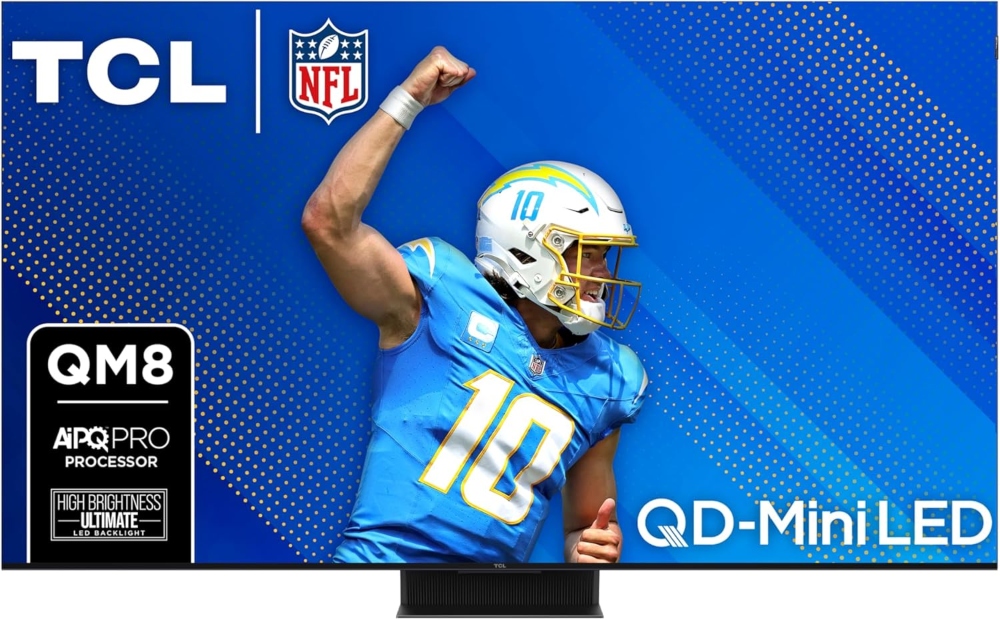
TCL has shaken up the television landscape over the last five years, and the 2024 QM8 is its boldest stroke yet. Sitting comfortably in the premium midrange category, the QM8 offers a jaw-dropping combination of performance, features, and price. The 75-inch version has particularly turned heads with its staggering 2,300+ local dimming zones, peak brightness north of 2,000 nits, and full-array Mini-LED backlighting—all at a price that undercuts many competitors by a wide margin.
The display itself is a marvel of layered precision. A quantum-dot film filters and refines color wavelengths, delivering around 97% of the Rec.2020 color gamut—far above most LED TVs. This is backed by TCL’s optical bonding technique, where the Mini-LED layer is directly fused with the diffuser plate, reducing light scatter and improving contrast uniformity. Combined with the new AIPQ Engine Gen 3, which analyzes and adjusts gamma, contrast, and sharpness on a per-scene basis, this TV provides some of the most dynamic HDR visuals you can get without going OLED.
Where the QM8 really punches above its weight is brightness and contrast. With over 2,000 nits of peak HDR brightness, it rivals the most luminous TVs on the market. Local dimming zones respond swiftly, darkening letterbox bars and preserving detail in nighttime scenes while making fireworks, explosions, and headlights sear with lifelike realism
TCL didn’t forget gamers either. The QM8 boasts a native 120 Hz panel, but it supports VRR up to 240 Hz via TCL’s Game Accelerator feature, making motion incredibly fluid in competitive titles. Input lag is excellent at around 8 ms, and the TV supports Dolby Vision Gaming, VRR, FreeSync, and ALLM. HDMI 2.1 is included on two ports, alongside eARC and a full-speed USB for local content.
On the audio front, the QM8 has a built-in subwoofer tucked into its metal chassis—a rare inclusion even among higher-end TVs. This rear-firing driver adds depth and rumble to explosions and cinematic bass drops, making the audio experience surprisingly full-bodied for a set with no external speakers.
One standout detail is the height-adjustable stand, which lets users elevate the TV to clear a soundbar—something you don’t realize you need until you get stuck propping up your soundbar on books. The design is minimalist and premium, with ultra-thin bezels and a metallic finish that doesn’t scream “budget brand.”
TCL’s Google TV interface is fast, well-supported, and clean, with wide app support including Netflix, Apple TV+, Prime Video, and Disney+. Voice search through Google Assistant is responsive, and TCL’s own dashboard interface for settings and optimization is simple and intuitive.
Drawbacks? A few. Because it uses a VA panel, viewing angles are narrower than OLED or wide-angle LCDs, and off-axis contrast drop is noticeable. Near-black uniformity isn’t always perfect—dim scenes can show slight patchiness, especially in very dark content. Also, while the built-in subwoofer is a bonus, the sound system lacks the nuance and imaging of premium soundbars or multi-speaker TVs like Sony’s Acoustic Surface lineup.
Trivia: TCL manufactures its own panels and backlights in-house—something most brands (even Samsung) no longer do. That vertical integration lets TCL pack more features in at lower prices, and the QM8 is the best example yet of that advantage in action.
Historically, the QM8 evolved from TCL’s 6-Series, which built a cult following starting in 2018 for delivering affordable quality. The QM8 now leads TCL’s premium tier, finally competing neck-and-neck with the big three (Sony, LG, Samsung) while still undercutting them on price.
For users seeking flagship brightness, immersive gaming, and broad HDR support without entering OLED pricing territory, the TCL QM8 delivers ridiculous value. It might not win awards for wide viewing angles or aesthetic minimalism, but if you’re after sheer firepower and gaming versatility, it’s a heavyweight champion.
75+ user ratings with an average of 4.6
#5: Hisense U8N ULED Mini-LED 4K TV (2025)($$)

The Hisense U8N might be the biggest surprise of 2025—not just because it performs so well for the price, but because it obliterates long-standing expectations for what a “budget-friendly” TV brand can achieve. With Mini-LED backlighting, cutting-edge gaming support, and eye-searing brightness levels topping 3,000 nits, the 75-inch U8N is arguably the most aggressively competitive TV Hisense has ever released.
The U8N is built around Hisense’s proprietary Peak Light Array system, which delivers pinpoint luminance control across more than 1,600 local dimming zones. The display’s HDR rendering is spectacular—ranging from searing lightning bolts to smoky shadow detail—all executed with a tight grip on blooming and light bleed. Dolby Vision IQ, HDR10+, and HLG are all supported, and tone mapping is handled by Hisense’s new Hi-View Engine X, which analyzes up to 4,000 frame zones in real time for smarter light distribution.
A standout for gamers, the U8N features a true 240 Hz native refresh rate—the first consumer-grade 4K TV to do so—allowing ultra-smooth visuals during fast motion. VRR, ALLM, Dolby Vision Gaming, and AMD FreeSync Premium Pro all come standard. Input lag hovers around 7–8 ms in Game Mode, and a dedicated Game Menu UI provides granular customization for performance preferences.
Design-wise, the U8N embraces a premium look, with a metallic bezel, a floating center stand, and an anti-glare screen layer that competes with Samsung’s best. It supports IMAX Enhanced and features Filmmaker Mode, which disables post-processing for pure cinematic presentation. Hisense also includes a rear-facing woofer, bolstering bass output beyond typical TV standards.
Smart TV duties are handled by Google TV, which is fluid and deeply integrated with Chromecast, Assistant, and third-party apps. While slightly slower than Tizen or webOS in some transitions, the UI is clean and stable.
Drawbacks include the somewhat bulky rear chassis and inconsistent gray uniformity during dark scenes, though neither issue impacts most use cases. Also, while the image out-of-box is excellent, it benefits significantly from calibration to correct cool color tones and slight gamma inconsistencies.
Fun fact: the U8N is the first Hisense TV built and assembled in the company’s new Georgia-based plant, making it the first U.S.-assembled Mini-LED TV from the brand. It’s part of Hisense’s effort to increase U.S. market penetration while reducing emissions from overseas shipping.
The U8N is the product of a decade-long evolution from Hisense’s early ULED experiments in 2014. What began as a mid-tier play on “better than LED” has matured into a serious premium contender—one that can stand toe-to-toe with the industry’s biggest names.
If your budget falls short of Sony or Samsung pricing—but you still want performance that can match them—the U8N is your dream screen. It’s blindingly bright, effortlessly fast, and uncompromisingly engineered for a fraction of the cost.
30+ user ratings with an average of 4.5
#6: Sony Bravia XR X95L Mini-LED 4K TV ($$)

The Sony Bravia XR X95L stands as one of the most masterfully engineered LED/LCD TVs ever created. It represents the apex of Sony’s Mini-LED technology, pairing their Cognitive Processor XR with advanced local dimming algorithms and hardware precision that elevate what VA-based displays are capable of. The X95L is a performance-oriented, cinema-calibrated powerhouse designed for those who want OLED-like shadow detail and superior brightness, without the risks or constraints of self-emissive panels.
In its 75-inch version, the X95L boasts roughly 1,800 independently controlled dimming zones. Sony’s unique local dimming algorithm is not only faster than its competitors—making adjustments at sub-millisecond speeds—but also predictive. Rather than waiting for a scene’s peak brightness to trigger dimming shifts, it anticipates luminance changes and makes preemptive tweaks to prevent blooming or halos. The result is a visually smooth and distraction-free image that excels in both high-contrast movie scenes and tricky edge-lit scenarios like fireworks or streetlamps in dark backgrounds.
The real brains behind this performance is the Cognitive Processor XR. Unlike conventional SoCs, which apply contrast or color enhancements frame-by-frame, the XR processor breaks each frame into “zones of attention” based on human perception. It boosts detail and depth in the same regions the human eye naturally focuses on—like a character’s eyes in close-up or a sunlit street vanishing into shadow. It’s a technique rooted in neuroscience, and the visual benefits are dramatic: faces look natural, shadows retain depth without crushing, and colors are precisely toned to avoid oversaturation.
Sony’s Mini-LED approach also delivers high brightness—around 1,600 nits peak in HDR—but with controlled highlights that never overpower the image. HDR10, HLG, and Dolby Vision are supported, and the X95L applies its own tone mapping rather than relying on source metadata, allowing greater control over HDR fidelity. Movies like Dune or Blade Runner 2049 come alive with neon-soaked shadows and incredible contrast transitions, creating an image that competes fiercely with OLEDs—especially in bright rooms.
On the audio front, the X95L uses Acoustic Multi-Audio+, a system that places sound positioning tweeters at both the top and sides of the screen. These drivers physically steer dialogue and effects to match on-screen motion. This, combined with a 60-watt multi-speaker array, creates a convincing illusion of spatial audio even without a soundbar.
Gamers will appreciate the inclusion of two HDMI 2.1 ports with full bandwidth for 4K at 120 Hz, VRR, and ALLM. While the VRR range is narrower than competitors (48–120 Hz), it’s stable and flicker-free. Input lag is slightly higher at 17 ms, making it less ideal for pro-level e-sports but more than adequate for cinematic and casual gameplay. PS5 owners benefit from Auto HDR Tone Mapping and Auto Genre Mode, helping to maximize the visual impact of games like Horizon Forbidden West or Spider-Man 2.
Build quality is pure Sony—robust, minimalist, and premium. The X95L’s wide-angle filter preserves brightness and color off-axis better than most VA panels, and the “Seamless Edge” industrial design uses recycled plastics derived from old DVDs. Sony claims this helps cut down virgin plastic usage by up to 60%, an admirable step toward sustainability.
Cons? For starters, the Google TV interface, while robust, can be sluggish at times. Sony also continues to omit HDR10+ support, which, while less critical than Dolby Vision, is still a format increasingly used by Amazon Prime Video and others. And though brightness is excellent, it doesn’t hit the dazzling 2,000+ nit territory of Samsung or Hisense’s best.
Historically, the X95L evolves from Sony’s venerable X950 line, but it marks a massive leap due to the switch from full-array to Mini-LED. The “L” model also improves thermal regulation, allowing for sustained brightness in long HDR scenes—a weakness in many previous Sony LED sets.
Overall, the X95L is a reference-grade LED TV that captures the spirit of high-end cinema with clinical precision. While it doesn’t cater as much to bleeding-edge gamers as Samsung or LG, it’s hard to top for pure movie immersion, shadow fidelity, and craftsmanship. It may be one of the most understated TVs on this list, but in a calibrated room, it’s nothing short of breathtaking.
20+ user ratings with an average of 4.7
#7: Samsung S95D QD-OLED 4K TV ($$$)

The Samsung S95D marks the third generation of QD-OLED panels and feels like a model that finally realizes the full potential of this hybrid display tech. By blending self-emissive OLED pixels with color-enriching quantum dots, the S95D achieves vibrant, accurate color and infinite contrast, but with one major twist: a proprietary anti-glare “Glare Free” matte coating that enables OLED’s inky blacks in well-lit environments—something no other OLED on the market can claim.
Available in 55, 65, and 77 inches, the S95D reaches up to 1,650 nits in HDR peaks. That’s a dramatic leap from traditional OLEDs and finally makes OLED viable in bright rooms. Even better, the quantum-dot layer ensures color doesn’t fade under high brightness, as is common with white OLEDs that use a boosting white sub-pixel. Whether it’s a snowy landscape at noon or a neon-lit cityscape, the S95D renders each scene with vivid punch and absolute blacks simultaneously.
The Glare Free matte finish deserves special attention. Developed using nano-patterned photolithography techniques borrowed from Samsung’s Galaxy S series, it minimizes reflections while preserving contrast and image sharpness. You can watch a dark scene at 3 PM with sunlight pouring into the room and still see shadow detail—an OLED first.
Gaming is another area where the S95D shines. With four HDMI 2.1 ports, full-bandwidth 4K at 144 Hz, VRR, FreeSync Premium Pro, and Samsung’s Game Hub (offering cloud gaming without a console), it’s built for the modern gamer. Input lag measures around 9 ms in Game Mode, and the Game Bar 4.0 allows for real-time frame rate monitoring, aspect ratio changes, and game optimizer toggles on the fly. Dolby Vision Gaming isn’t supported—Samsung sticks to HDR10+—but in practice, most games still look phenomenal.
Samsung’s NQ4 AI Gen2 processor brings dynamic tone mapping, color correction, and scene-based sharpening into play. It processes object-level HDR and optimizes content with 20 neural networks trained on thousands of real-world image samples. Combined with the QD-OLED’s inherent advantages in contrast and off-angle viewing, the result is dazzling consistency from every seat in the room.
Audio isn’t neglected either. The S95D features Object Tracking Sound+ with upward- and side-firing speakers, supporting Dolby Atmos. While it’s still advisable to use a dedicated soundbar for cinematic experiences, the onboard sound is surprisingly full and directional for a screen this thin—just 0.3 inches at its slimmest point.
Design-wise, the S95D is jaw-droppingly sleek. The “Infinity One” profile makes it look like it floats off the wall, and it uses Samsung’s One Connect Box to offload ports and cables into a separate enclosure. This keeps the display impossibly thin and the setup clean and minimal.
Cons? A few remain. There’s still no Dolby Vision support, which can impact streaming quality for premium Netflix or Disney+ content. Also, the matte coating, while brilliant in ambient light, can slightly mute deep shadow gradations compared to glossy OLEDs in dark rooms. Some videophiles may find this tradeoff undesirable, though it’s more theoretical than practical.
Fun fact: Samsung’s QD-OLED panels are made by Samsung Display but are used in Sony and other brands’ top TVs. However, the S95D is the only one that includes the Glare Free matte filter—a proprietary technology exclusive to Samsung’s 2025 models.
Historically, the S95D builds on the S95B (2022) and S95C (2023), both of which were highly acclaimed but limited by glare or modest brightness. With the S95D, Samsung’s QD-OLED evolution reaches its most mature and consumer-ready phase yet.
If you love OLED’s depth and infinite contrast but live in a bright environment or dislike screen reflections, the S95D is your unicorn. It combines flagship-grade HDR, cinematic black levels, bleeding-edge gaming features, and showroom-quality design into one ultra-premium package.
160+ user ratings with an average of 4.0
#8: LG C4 OLED Evo 4K TV ($$)

The LG C4 continues LG’s long-standing tradition of offering a high-end OLED experience in a versatile, consumer-friendly package. As the successor to the wildly successful C3, the C4 offers modest yet meaningful improvements in brightness, processing, and usability. For those looking to enter the OLED world without jumping to the ultra-premium G-series or QD-OLED territory, the C4 remains the most balanced option—ideal for gamers, streamers, and movie lovers alike.
At the core of the C4 is LG’s refined OLED Evo panel paired with the Alpha 9 Gen 7 processor. While it doesn’t include MLA like the G4, it still delivers a noticeable brightness bump—peaking around 970 nits in small highlights and 150–200 nits higher in full-field brightness than its predecessor. This improved luminance, combined with superior ABL (Automatic Brightness Limiter) behavior, allows HDR content to look more consistent and stable.
The Alpha 9 Gen 7 chip uses deep learning trained on over 4,000 HDR scenarios to enhance contrast, improve noise reduction, and provide object-based sharpening. It also features AI Picture Pro, which can intelligently distinguish between faces, skies, and text to apply targeted enhancements. Movies and sports alike benefit from the increased clarity and natural tone reproduction, while Filmmaker Mode disables unnecessary post-processing for true-to-intent viewing.
Gaming on the C4 is world-class. All four HDMI 2.1 ports offer 48 Gbps bandwidth for 4K at 120 Hz, VRR, G-Sync, and FreeSync. Input lag clocks in around 9 ms, and the Game Optimizer UI has been revamped for easier access to key settings like genre modes, black stabilizer, and frame rate indicators. LG has also enabled Dolby Vision Gaming at 120 Hz, offering cinematic color depth and contrast for supported titles.
While the panel design is unchanged from the C3, the C4 adds small but useful refinements. The screen is slightly more robust, with better heat dissipation and reduced risk of image retention. The stand remains low-profile, however, and may require a riser for proper soundbar clearance unless wall-mounted.
The audio system gets a minor upgrade as well. A 40-watt 2.2 channel system provides balanced stereo performance, and AI Sound Pro can up-mix stereo content into virtual 9.1.2 surround using psychoacoustic tricks. Still, most users will want to pair this set with an external soundbar or speaker system.
Smart features run on webOS 24, which is now faster, supports multi-user profiles, and adds Quick Cards for better content navigation. However, the platform still promotes LG Channels and ads on the home screen—a recurring gripe for users who prefer cleaner UI environments.
Fun fact: the C4 panel uses 30% less cobalt and rare earth metals than the C2, part of LG’s continued effort to reduce the environmental footprint of its OLED line.
Historically, the C Series has been LG’s mainstream OLED option since the C7, and the C4 solidifies its reputation as the best all-purpose OLED you can buy without going ultra-premium.
930+ user ratings with an average of 4.5
#9: Vizio MQX Quantum 4K TV ($$)

Vizio’s MQX Quantum 4K TV is a testament to how far value-focused television has come. The MQX doesn’t pretend to be a flagship OLED killer—but what it does is just as important: it delivers strong HDR performance, high refresh rate gaming support, and wide color capabilities at a price that makes upgrading to 4K much more accessible. In many ways, it represents the democratization of premium features that were once exclusive to four-figure displays.
At the core of the 75-inch MQX is a full-array local dimming panel supported by 42 local dimming zones. While that’s far fewer than the 1,000+ zones on Mini-LED giants like TCL’s QM8 or Hisense’s U8N, it’s enough to enable solid contrast control and limited blooming in most real-world scenes. The TV peaks at about 1,000 nits in HDR mode—a notable figure given its price tier—and can deliver impressive brightness in highlights while preserving decent detail in darker areas.
Color reproduction is one of the MQX’s most underappreciated strengths. It uses a quantum dot layer to achieve over 90% coverage of the DCI-P3 color space. This results in more vivid reds, lush greens, and vibrant blues—especially noticeable in animated content or HDR blockbusters. HDR formats include Dolby Vision, HDR10+, and HLG, which makes it one of the few budget-tier models to cover every major standard.
Gamers will be pleasantly surprised by how much the MQX offers. It supports HDMI 2.1 on two ports with 4K at 120 Hz, VRR, and AMD FreeSync Premium. Input lag measures under 10 ms in Game Mode, and the TV can simulate a 240 Hz refresh rate using black frame insertion. Vizio’s Game Dashboard lets players toggle FPS displays, HDR mode, black level boost, and even built-in reticle overlays for shooters. These features may sound gimmicky, but competitive players looking for performance on a budget will find them useful.
Motion handling is respectable, especially given the 120 Hz native panel. Motion interpolation settings help reduce judder for sports and fast-moving scenes, though soap opera effect is still present at higher settings. The TV handles 24p film cadence well, a major plus for movie lovers using Blu-ray or streaming.
Audio, while not spectacular, is serviceable. The MQX sports dual down-firing speakers with DTS:X and Dolby Atmos passthrough support. The onboard sound lacks the spatial depth and clarity of higher-end models, but in a small-to-medium room, it gets the job done. Most users will benefit from pairing it with a Vizio V-Series or Elevate soundbar to enhance the viewing experience.
Smart features run on Vizio’s SmartCast OS, which has come a long way in recent years. It now supports most major apps like Netflix, YouTube, Apple TV+, Hulu, and Disney+, though app loading speeds can lag behind competitors like Roku or Google TV. SmartCast supports both Apple AirPlay 2 and Chromecast built-in, giving users flexibility in casting content from phones or tablets. However, it still lacks an app store in the traditional sense and is more reliant on pre-loaded apps.
The design is minimal but attractive, with a brushed bezel, narrow stand legs, and a matte finish that reduces reflections. Build quality is solid, though not premium. One common critique is the included remote, which feels dated, lacks backlighting, and has small buttons that can be hard to read in the dark.
Cons include noticeable blooming during scenes with stark contrast (e.g., white text on black background), limited zone count leading to some patchy black uniformity, and inconsistent grayscale handling out-of-the-box. Calibration improves things substantially, but that’s not something most buyers in this segment typically pursue.
What makes the MQX historically significant is how it extends Vizio’s value legacy. The company burst onto the scene in the early 2000s by offering HD plasmas at prices hundreds of dollars below competitors. Since then, its DNA has remained the same—aggressively competitive pricing, practical features, and wide retail availability. The MQX sits in the space once occupied by the iconic Vizio M-Series but retools the line for HDR, gaming, and streaming in the 4K era.
Fun fact: Vizio still engineers and designs all of its firmware and SmartCast interface in-house at their California headquarters, keeping development close to the brand’s consumer-first roots.
All in all, the MQX Quantum isn’t the flashiest TV on this list—but for those on a tight budget who don’t want to sacrifice 120 Hz gaming, full HDR support, or wide color gamut, it punches well above its class. In an era of $3,000 OLEDs and high-end Mini-LED beasts, the MQX is proof that smart compromises can still deliver truly impressive results.
#10: Samsung The Frame LS03D QLED 4K TV ($$)

Samsung’s The Frame LS03D is a one-of-a-kind television that doesn’t just blend into your decor—it becomes part of it. Now in its 2025 form, the LS03D delivers the most polished and complete execution of Samsung’s “Lifestyle TV” concept to date, combining solid QLED performance with unique art display capabilities that cater to a completely different set of priorities than raw specs alone.
What sets The Frame apart isn’t just its flush-mount design or picture frame aesthetics—it’s the underlying philosophy. Most TVs turn into a black mirror when not in use; The Frame transforms into a vibrant art gallery. With its matte ART Screen finish, anti-reflective coating, and over 2,500 pieces of curated art available via Samsung’s Art Store subscription, this set invites you to use your wall space as living, breathing decor.
Technically, the LS03D is no slouch. Its 4K QLED panel offers full HDR support (HDR10+, HLG, and HDR10), a peak brightness of about 1,000 nits, and impressively rich color thanks to Samsung’s Quantum Dot layer. While it lacks the ultra-high brightness and dimming zone count of the QN90D, it performs admirably for standard HDR content, especially in moderately lit rooms.
The screen’s matte coating is more than just a stylistic feature. It uses a micro-etched texture that disperses ambient light evenly across the panel surface, virtually eliminating reflections. Unlike glossy screens that show every window or ceiling light, The Frame’s finish preserves color and contrast even when the room is lit. This makes it one of the few TVs that’s equally suited to both daylight viewing and nighttime ambience.
Samsung includes its Slim Fit wall mount in the box, allowing the LS03D to sit nearly flush—just 0.66 inches—from the wall, mimicking the depth and presence of a real canvas. Interchangeable magnetic bezels (sold separately) snap on and off without tools and come in a variety of styles—from Modern to Beveled to Rustic—to match your home’s aesthetic. The One Connect box simplifies cable management by moving all inputs to a discrete external hub that connects to the screen via a single nearly invisible fiber-optic cable.
Gamers may be disappointed by the 60 Hz refresh rate, especially when Samsung’s other QLEDs support 120–144 Hz with full HDMI 2.1. Still, casual gaming works well enough, and input lag is reasonably low (about 14 ms). The Frame isn’t marketed as a gaming TV, but it can handle the occasional session of Mario Kart or Minecraft with ease.
Smart features are powered by Tizen OS, now faster and cleaner than ever. Multi-user profiles, voice control, and smart home integration via SmartThings are all included. Samsung has also improved Art Mode efficiency—the new Motion Sensor detects room activity and turns the screen off when no one is present, bringing standby power down to less than 1 watt in idle mode. The TV also automatically adjusts brightness and color tone of artworks to suit the room’s lighting conditions.
Audio is competent but unremarkable. A 40-watt 2.0 channel system provides acceptable clarity for casual viewing, but lacks low-end punch and spatial imaging. Thankfully, The Frame supports Q-Symphony and Dolby Atmos passthrough via eARC, making it easy to pair with a compatible soundbar for a more immersive experience.
Limitations? The Frame isn’t ideal for serious home theater users. Its contrast performance, while solid, isn’t as deep as that of full-array local dimming sets or OLEDs. The panel uses edge lighting, which leads to modest black levels in dark scenes. Additionally, the art store requires a subscription to access the full library, though a selection of free art is included.
Interesting fact: The Louvre, Prado, and Van Gogh Museum have licensed ultra-high-resolution scans of dozens of their most famous pieces exclusively for The Frame. The 2025 model includes a 620-megapixel version of the Mona Lisa calibrated to mimic the Louvre’s exact gallery lighting—a world first for a consumer TV.
Historically, The Frame debuted in 2017 and was met with skepticism—but by 2024, it had become Samsung’s best-selling lifestyle TV line. The 2025 LS03D refines that vision with better reflection handling, improved ambient sensors, and more seamless integration with home decor.
For those who see their TV as an extension of their interior design—not just a device—the LS03D is unmatched. It delivers solid QLED performance when needed, and acts as a high-end digital canvas the rest of the time. It’s not a cinephile’s dream screen or a gamer’s top pick—but for aesthetes, decorators, and design-forward households, it’s a masterpiece in disguise.
750+ user ratings with an average of 4.1
Side-By-Side Comparisons
| TV (Ranked) | Display Tech | Peak Brightness | Refresh Rate | HDR Support | HDMI 2.1 Ports | Gaming Extras | Audio Highlights | Pros | Cons | ||
|---|---|---|---|---|---|---|---|---|---|---|---|
| #1: Samsung QN90D Neo QLED |  | $$$ | Mini-LED VA QLED | ≈ 2,300 nits | 144 Hz | HDR10, HDR10+, HLG | 4 | 9 ms lag, Game Bar, FreeSync Premium Pro | OTS Pro 4.2.2 (Q-Symphony) | Blazing HDR punch; superb anti-glare; class-leading gaming toolkit | Narrower viewing angles; no Dolby Vision; Tizen ads |
| #2: Sony A95L QD-OLED |  | $$$ | QD-OLED | ≈ 1,400 nits | 120 Hz | Dolby Vision, HDR10, HLG | 2 | Auto HDR Tone Map (PS5), 16 ms lag | Acoustic Surface Audio+ 60 W | Perfect blacks & color purity; reference-grade motion | Highest price; OLED burn-in caution; only 2 HDMI 2.1 |
| #3: LG G4 OLED Evo |  | $$$ | WOLED + MLA | ≈ 1,600 nits | 120 Hz | Dolby Vision, HDR10, HLG | 4 | 9 ms lag, G-Sync/FreeSync, Game Optimizer | 60 W 2.2 + WOW Orchestra | Gallery-slim wall mount; near-reference color; excellent gaming | Still dims in sun-soaked rooms; OLED image-retention risk |
| #4: TCL QM8 Mini-LED |  | $$$ | Mini-LED VA QLED | ≈ 2,000 nits | 120 Hz (240 Hz VRR) | Dolby Vision IQ, HDR10+, HLG | 2 | Game Accelerator 240, 8 ms lag | Built-in subwoofer + 2.1 | Huge zone count for price; towering brightness; strong value | VA viewing-angle drop; some black-uniformity mottling |
| #5: Hisense U8N Mini-LED |  | $$ | Mini-LED VA QLED | ≈ 3,000 nits | 240 Hz native | Dolby Vision IQ, HDR10+, HLG | 4 | 7 ms lag, DV Gaming, FreeSync Premium Pro | Rear woofer, IMAX Enhanced | Brightest 4 K TV; first true 240 Hz panel; aggressive pricing | Thick chassis; cool tint out-of-box; Google TV stutters |
| #6: Sony X95L Mini-LED |  | $$ | Mini-LED VA | ≈ 1,600 nits | 120 Hz | Dolby Vision, HDR10, HLG | 2 | PS5 Auto modes, 17 ms lag | Acoustic Multi-Audio 60 W | Predictive dimming kills blooming; wide-angle filter | Fewer HDMI 2.1; no HDR10+; premium cost |
| #7: Samsung S95D QD-OLED |  | $$$ | QD-OLED + Matte | ≈ 1,650 nits | 144 Hz | HDR10+, HDR10, HLG | 4 | 9 ms lag, Game Hub cloud, FreeSync Premium Pro | OTS+ Atmos, One Connect | OLED blacks with daylight-proof screen; ultra-slim | No Dolby Vision; matte layer mutes deepest shadows |
| #8: LG C4 OLED Evo |  | $$ | WOLED Evo | ≈ 970 nits | 120 Hz | Dolby Vision, HDR10, HLG | 4 | DV Gaming 120 Hz, 9 ms lag, Game Optimizer | 40 W 2.2, AI Sound Pro | Best price-performance OLED; wide app support | Lower peak brightness; stand blocks soundbar |
| #9: Vizio MQX Quantum | 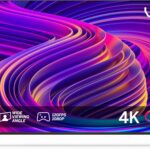 | $$ | Full-Array QLED | ≈ 1,000 nits | 120 Hz (240 Hz BFI) | Dolby Vision, HDR10+, HLG | 2 | 10 ms lag, FreeSync, Game Dashboard | 20 W stereo, DTS:X passthrough | Inexpensive 120 Hz + full HDR suite; strong color | Only 42 dimming zones; SmartCast sluggish; dated remote |
| #10: Samsung The Frame LS03D |  | $$ | Edge-Lit QLED | ≈ 1,000 nits | 60 Hz | HDR10+, HDR10, HLG | 4 | Casual gaming OK (14 ms) | 40 W 2.0, Q-Symphony | Art Mode, matte anti-glare, swappable bezels | 60 Hz only; edge lighting limits contrast; art-store fee |