Small Rooms Reward Precision
A small home theater can feel more immersive than a large one because the screen, speakers, and seating sit closer to the viewer. The challenge is that mistakes also become more obvious. A screen that is too high feels uncomfortable, a subwoofer can overwhelm the room, and one messy cable path can dominate the wall. The best small-room setups treat every inch as valuable. They use the room’s limits as design guidance, choosing equipment that fits the viewing distance, furniture that supports the layout, and acoustic choices that make dialogue clear without turning the space into a padded studio.
Start With the Viewing Distance, Not the Biggest Screen
The easiest small-room mistake is buying the largest screen that fits on the wall. Big can be wonderful, but only when the viewer can take in the picture comfortably. If the seating is close, an oversized screen may force constant head movement or make lower-resolution content look rough. The better approach is to measure the primary seat, consider the content you watch most often, and choose a screen size that feels cinematic without becoming tiring.
Mounting height matters just as much. In compact rooms, people often place the display above storage or above a fireplace because wall space is limited. That can work for casual viewing, but a theater setup should keep the center of the screen near seated eye level when possible. A lower, cleaner mount usually feels more expensive and more comfortable.
Projectors can work in small rooms, but they require honest light control and throw-distance planning. Ultra-short-throw projectors are attractive because they sit near the wall, yet they still need a suitable screen surface and stable furniture. For many small rooms, a high-quality TV is simpler, brighter, and easier to live with.
Choose Audio That Fits the Room’s Air Volume
Small rooms do not need giant speakers to sound powerful. In fact, oversized speakers can create placement problems and muddy bass if they are squeezed into corners. A compact 3.1, 5.1, or soundbar-based system can be excellent when the front soundstage is centered, the subwoofer is positioned carefully, and the room includes enough soft surfaces to control reflections.
Dialogue clarity should be the priority. A strong center channel, or a soundbar that handles center information convincingly, will do more for everyday enjoyment than a system that only impresses during explosions. The room should let voices feel anchored to the screen, not trapped inside a cabinet or bouncing from a side wall.
Furniture Has to Work Harder
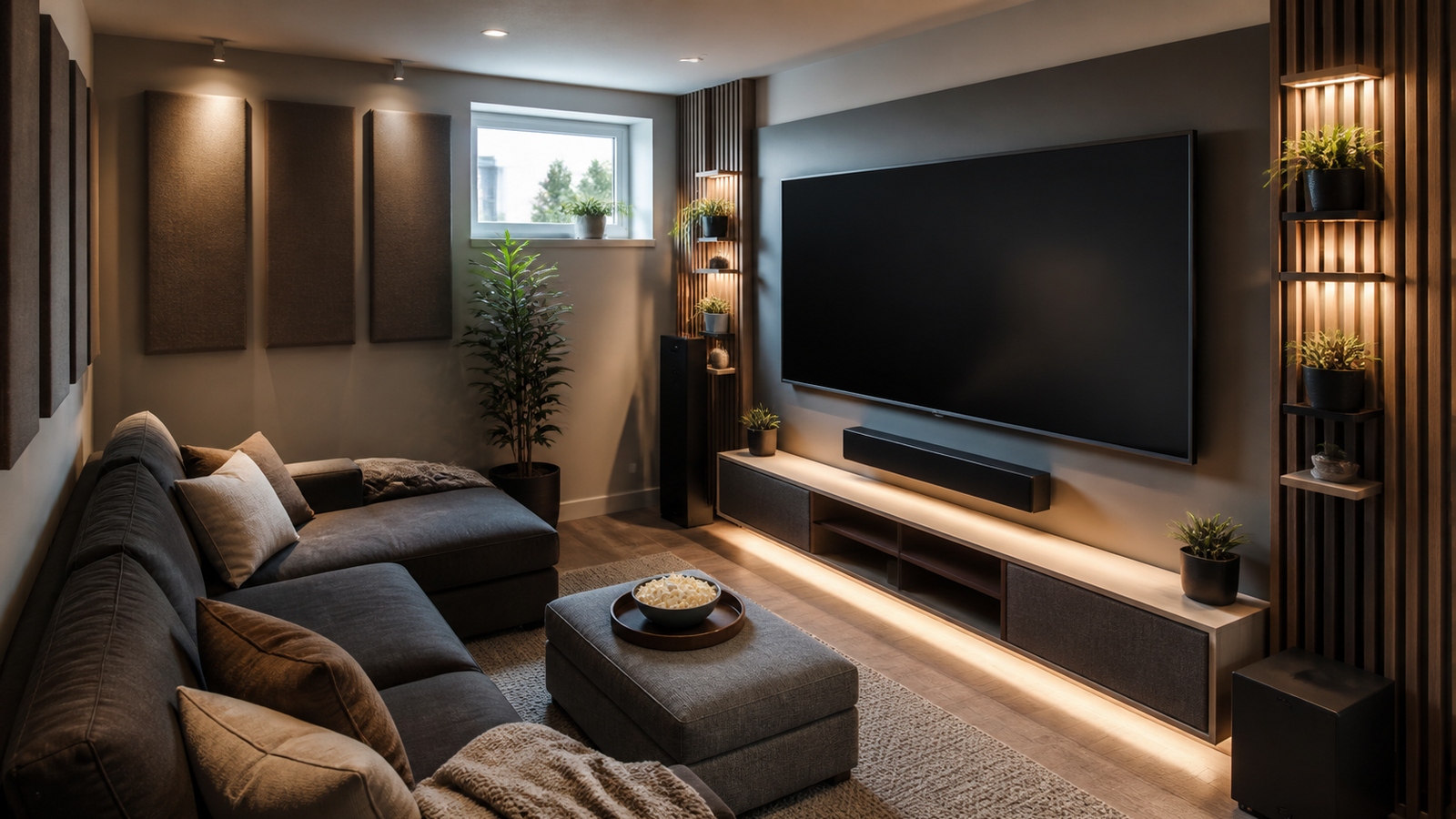
Small theater seating should support the room instead of swallowing it. Deep recliners may look cinematic, but they can leave too little walkway space or push viewers too close to the screen. A compact sectional, apartment-scale sofa, loveseat, or two lounge chairs can make the room feel intentional without crowding the walls.
The best furniture choices also solve storage. Ottomans can hold blankets and controllers. Narrow side tables can keep drinks away from equipment. A floating console can clear floor space while hiding streaming boxes and game systems. When every piece has a job, the room feels larger.
Do not ignore traffic flow. People should be able to enter, sit, stand, and reach storage without stepping through a tangle of chargers or squeezing past speaker stands. A small home theater feels successful when it is easy to use, not just when the screen looks impressive from one photo angle.
Control Light and Reflection Before Adding More Gear
Light control is a small room’s secret advantage. Fewer windows and shorter wall spans can make shades, curtains, and darker finishes easier to manage. Even modest blackout curtains can dramatically improve perceived contrast, especially for projectors and glossy displays.
- Use matte or eggshell wall finishes near the screen.
- Place lamps behind or beside seating rather than opposite the display.
- Add a rug if the room has hard flooring.
- Use curtains or fabric panels to soften both light and sound.
Reflection control does not mean painting everything black. Mid-tone colors, textured fabrics, and controlled accent lighting can keep the room stylish while protecting the picture. The goal is to stop glare from stealing attention.
Make the Setup Easy to Reset
Small rooms become frustrating when they collect visible clutter. Game controllers, remotes, chargers, headphones, blankets, and snack trays can overwhelm the design quickly. Closed storage near the screen or seating is not a luxury in a compact theater; it is how the room returns to calm between uses.
Cable management is equally important. Short runs still need planning, because cables are more visible when furniture sits close to the walls. Use in-wall rated cabling where appropriate, route power safely, and keep service access available. A clean setup also makes future upgrades less stressful.
The best small-room theater is not the one with the most equipment. It is the one that makes the room feel bigger, the screen feel natural, and the sound feel clear at normal listening levels. When the setup respects the space, a small room can deliver a surprisingly rich cinematic experience.
Use the Corners Without Letting Them Take Over
Corners are powerful in small rooms because they can hold storage, speakers, lamps, or acoustic treatment without stealing the center of the layout. They are also risky because bass gathers there, tall furniture can make the room feel smaller, and a corner-mounted display often creates awkward viewing angles. The best small theaters use corners for support functions while keeping the main screen and seating geometry simple.
A corner shelf can hold networking gear or a compact game console if ventilation is clear. A corner bass trap can improve sound without occupying the main wall. A slim floor lamp can create warm room light without reflecting directly on the display. These moves make the room work harder while preserving the main viewing path.
Avoid treating every corner as storage. When all four corners are filled, the room can feel squeezed. Leave at least one visual pause so the space has somewhere to breathe.
Keep the Front Wall Calm
In a small theater, the front wall carries a lot of responsibility. It holds the display, often supports sound, and sets the visual tone for the whole room. If that wall is crowded with shelves, decor, bright devices, and mismatched storage, the screen will feel smaller and the room will feel busier. A calm front wall makes the experience feel larger.
Calm does not mean bare. A low floating console, a pair of narrow acoustic panels, or a simple painted recess can give the wall structure. The point is to avoid visual competition around the picture. Small spaces benefit when the eye knows exactly where to rest.
This is especially important for gaming and subtitles, where attention moves quickly. A clean front wall helps the brain stay with the image instead of scanning the room.
Design for Quiet Operation
Mechanical noise feels louder in a small room. A projector fan, buzzing power supply, hard-drive hum, or rattling cabinet door can become distracting because the listener sits close to everything. Before adding more equipment, listen to the room when it is quiet. The solution may be as simple as moving a device, adding ventilation, or padding a cabinet contact point.
Heat management affects noise too. Components trapped in a tight cabinet may force fans to work harder. Give receivers, consoles, and streaming hardware enough space to stay cool. A quiet room feels more premium, and it also makes dialogue easier to follow at lower volume.
The final test is ordinary use. Sit in the main seat during a quiet scene, with the lights dimmed and the HVAC running. If the room remains comfortable and clear, the small theater is doing its job.
A Small Room Should Feel Deliberate From the Doorway
The final layer is first impression. When someone opens the door, the room should immediately make sense. The screen wall should feel organized, the seating should suggest where to sit, and the equipment should not demand explanation. This matters more in small rooms because there is less space for the eye to recover from clutter. A deliberate room feels larger before anyone turns on the display.
Use the entry view as a design test. If the first thing people see is a pile of cables, an off-center mount, or a console crowded with devices, the room will feel unfinished. If they see a calm wall, comfortable seating, and a few warm materials, the same square footage feels considered. This does not require expensive millwork. It requires editing what is visible and giving necessary items a place to disappear.
Sound should be part of that deliberate feeling as well. Place speakers so they look intentional, not temporary. If stands are necessary, choose ones that match the room and hide wire runs. If a soundbar is used, align it cleanly with the display or console. Small details become large details in compact rooms.
The best small-room setup is ultimately a confidence exercise. Choose a screen that fits, audio that performs without crowding, furniture that supports movement, and storage that resets the room quickly. When each decision respects the limits of the space, the result feels polished rather than compromised.
That is why small theaters can be so satisfying. They do not have room for waste. Every inch that works well makes the experience feel more focused, more comfortable, and more personal.
Test the Room With Real Content
Small-room decisions should be tested with the kind of content the household actually watches. A bright animated film, a dark drama, a sports broadcast, a video game, and a dialogue-heavy show all reveal different strengths and weaknesses. Demo clips can be useful, but they may hide everyday problems such as low voices, glare during daytime, or menus that are hard to read from the sofa.
Spend a full evening with the setup before calling it finished. Notice whether people shift seats, whether subtitles feel too small, whether the room gets warm, and whether anyone avoids using the system because it seems complicated. These observations are more valuable than another specification comparison.
Small rooms are easy to fine-tune because changes are contained. Moving a lamp, adding a rug, lowering a shelf, adjusting a subwoofer, or changing a picture preset can have an immediate effect. Use that advantage. The room does not need to be perfect on the first pass; it needs to be responsive to improvement.
Once the room works with real content, resist the urge to overfill it. The open space, clear wall, and simple storage are part of the success. A small theater remains excellent when it keeps its discipline.
The Best Small Setup Feels Inevitable
A small theater is finished when every choice feels like it belongs there. The screen size suits the seat, the speakers fit the walls, the furniture leaves room to move, and storage handles the objects that would otherwise pile up. Nothing feels oversized, temporary, or apologetic.
That sense of inevitability is what makes compact rooms special. With fewer square feet, there is less distance between design decisions and daily experience. Good choices are felt immediately.
TV Top 10 Product Reviews
Explore Philo Street’s TV Top 10 Product Reviews! Discover the top-rated TVs, access comprehensive reviews, and find the perfect screen for your space.