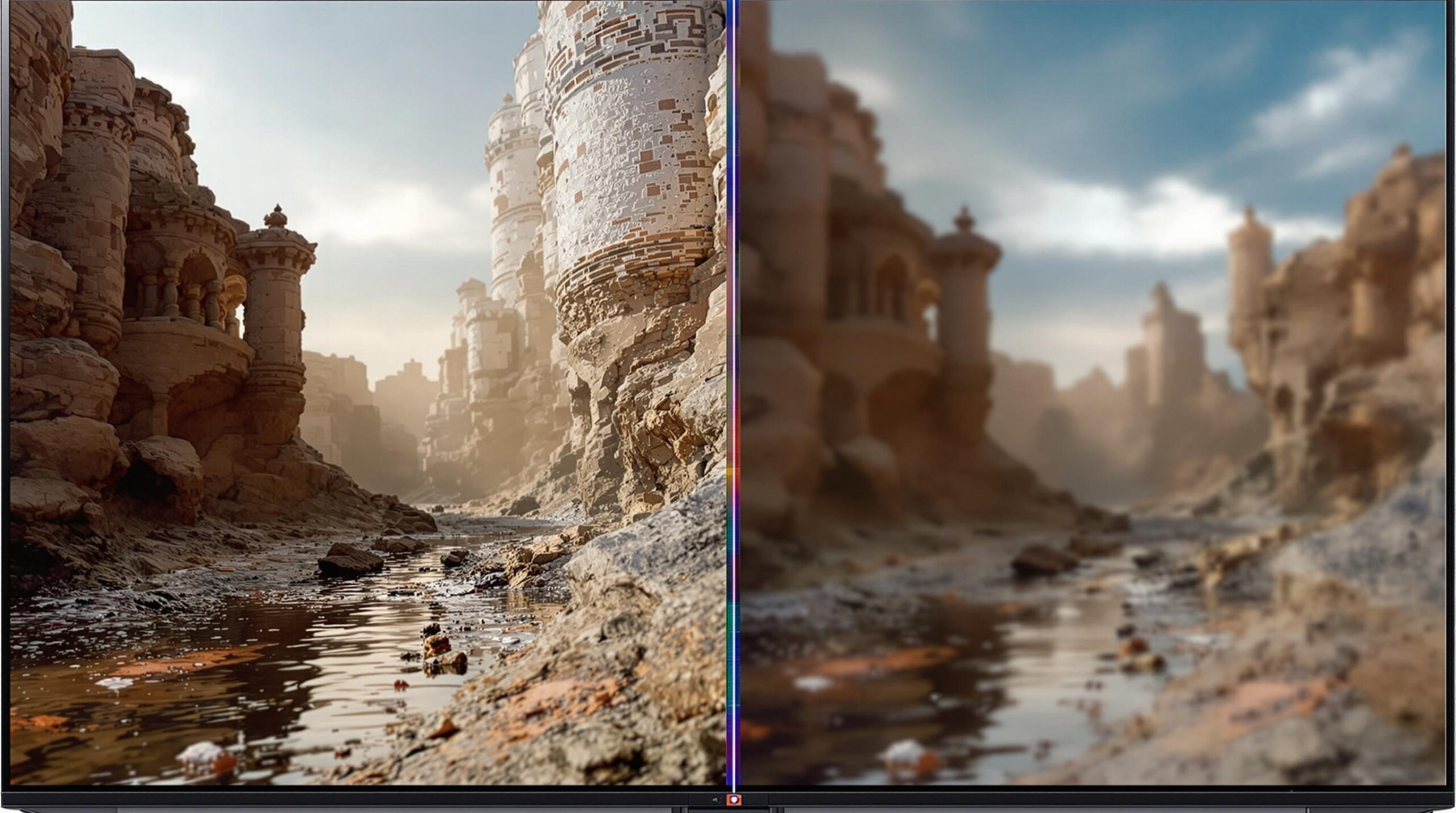

The terms “UHD” and “4K” are often used interchangeably in marketing and casual conversation, especially when discussing televisions. But in the world of display science and engineering, these two formats—while closely related—are not identical. Understanding the distinction between UHD (Ultra High Definition) and true 4K requires diving beneath the screen surface into the world of pixel structures, data transmission, and display panel chemistry. And when viewed through the high-performance capabilities of OLED technology, the line between UHD and 4K becomes not only technical but foundational to the visual experience. This article dissects the real meaning behind UHD and 4K, grounded in physics, chemistry, and engineering principles, all while staying accessible to non-experts.
The Basics: What Is UHD?
UHD stands for Ultra High Definition and is defined primarily by its resolution: 3,840 pixels horizontally by 2,160 pixels vertically. This totals just over 8.2 million pixels. UHD is standardized by the International Telecommunication Union (ITU) as a consumer-friendly enhancement over Full HD (1,920 x 1,080). As a format, UHD is meant for consumer television use and includes other improvements besides resolution, such as a wider color gamut, higher frame rates, and enhanced audio formats.
UHD resolution maintains the same 16:9 aspect ratio as HD, meaning it fits perfectly into existing display shapes and content formats without requiring cinematic aspect corrections. The choice of 3,840 horizontal pixels was a practical one—doubling the horizontal and vertical dimensions of Full HD (1920 x 1080) leads directly to 3840 x 2160, an ideal upscaling base for manufacturers and broadcasters alike.
What Is True 4K?
True 4K refers to a resolution standard originally established by the Digital Cinema Initiatives (DCI), a consortium of major movie studios. DCI 4K specifies a resolution of 4,096 x 2,160 pixels, which results in a wider image with a more cinematic 1.9:1 aspect ratio. This standard is used in professional film production and digital cinema projectors. The goal of 4K DCI was not just resolution enhancement, but also format unification for cinematic post-production workflows.
While UHD and 4K DCI share the same vertical pixel count, their horizontal resolutions differ. That extra 256 horizontal pixels in 4K DCI accounts for a wider image more suited for theatrical presentations. However, for home televisions and consumer devices, this resolution mismatch is often corrected through slight cropping or letterboxing, making UHD the default resolution for consumer-facing 4K media.
Pixel Structure and OLED Display Chemistry
Regardless of whether you’re displaying UHD or 4K content, the ability to resolve fine detail depends on how pixels are physically rendered on the screen. OLED panels utilize a self-emissive design in which each pixel emits its own light through organic electroluminescent materials. Each OLED pixel consists of subpixels—usually red, green, blue, and sometimes white (WRGB architecture)—each made from organic compounds engineered to emit specific wavelengths of light.
At a 3,840 x 2,160 UHD resolution, an OLED panel must integrate over 8.2 million individual pixels, each made up of multiple subpixels. The manufacturing precision required to fabricate these millions of microstructures, ensure consistent light emission, and maintain uniform pixel response is immense. Even small inconsistencies in the thickness of the organic emissive layer or the voltage levels across subpixels can result in visual anomalies such as banding, color shifts, or uneven brightness.
From a chemistry standpoint, OLED materials must be both photostable and thermally resilient. The organic layers are typically deposited via vacuum thermal evaporation (VTE) or inkjet printing, and must remain chemically inert under continuous excitation. For UHD resolution, this means consistent emission characteristics across millions of pixel clusters, which is essential for rendering both UHD and 4K content without degradation in clarity or color accuracy.
Understanding Pixel Density and Human Perception
A key reason UHD and 4K are conflated is that most consumers cannot visually discern the difference between 3,840 and 4,096 horizontal pixels—especially on a typical 55-inch or 65-inch OLED TV viewed from a standard distance. This limitation stems from the physiology of the human eye. The resolving power of the retina, measured in arcminutes per line pair, sets a limit on how much detail we can perceive based on viewing distance and screen size.
In engineering terms, the concept of pixels per degree (PPD) is used to quantify this. For a 65-inch OLED TV viewed from about 8 feet away, both UHD and 4K provide more detail than the eye can resolve. This is why UHD was deemed “close enough” to 4K for home use—there’s little perceivable benefit to pushing beyond UHD resolution on current consumer displays, unless screen sizes are exceptionally large or viewing distances are unusually short.
Engineering Bandwidth: UHD vs. 4K Signal Processing
Displaying UHD or true 4K content isn’t just about having enough pixels—it’s also about moving the right amount of data to those pixels fast enough. UHD video at 60 frames per second with 10-bit color and 4:2:2 chroma subsampling requires around 18 Gbps of bandwidth. True 4K with the same specs can push beyond that, especially if it’s being delivered uncompressed.
OLED TVs equipped with HDMI 2.1 ports are designed to handle such high-bandwidth content. The display’s internal processor must decode, map, and distribute that data to the pixel-driving circuits in real time. This involves memory buffers, signal decoders, and real-time rendering algorithms—all coordinated to ensure that each pixel on the OLED panel receives the correct luminance and color information in microseconds.
One critical difference emerges here: most UHD TVs are tuned for the 3,840 x 2,160 format and must downscale or crop native 4K (4096 x 2160) content to fit their panels. This introduces another layer of signal processing—resampling the image horizontally—which must be handled with great precision to avoid introducing artifacts or distortions. OLED’s fast pixel response and high uniformity reduce the visibility of such artifacts, making this transition largely imperceptible when engineered properly.
Aspect Ratio Considerations and Display Scaling
Another major difference between UHD and 4K lies in the content aspect ratio. UHD uses 16:9, while DCI 4K uses a wider 1.9:1 aspect ratio. On OLED televisions, which are almost universally 16:9, this means true 4K content will often be displayed with small black bars at the top and bottom (letterboxing) or will be cropped slightly to fit the screen’s native geometry.
The TV’s scaler engine, embedded in its system-on-chip (SoC), performs spatial mapping to conform the image to the display’s aspect ratio. High-end OLEDs from manufacturers like LG and Sony incorporate advanced AI-based upscaling and downscaling algorithms that identify edges, reduce ringing, and interpolate missing pixels with context-aware logic. This is a particularly demanding engineering challenge when preserving fine detail and avoiding motion artifacts in cinematic sequences.
Color Gamut and UHD Standards
UHD isn’t just about resolution; it also includes support for wider color gamuts, such as BT.2020, and higher dynamic range. OLED’s capability to turn off pixels completely and emit precise wavelengths makes it uniquely suited to take advantage of these wider gamuts. Each organic material used in an OLED pixel emits a narrow spectrum of light, which can be combined to produce exceptionally saturated colors.
True 4K content used in digital cinema often assumes DCI-P3 color space, while UHD strives toward BT.2020. OLED panels must therefore support a wide native gamut and employ a 3D color lookup table (LUT) to render each color value accurately. Display calibration tools adjust how raw signal values map to display-specific emission characteristics, maintaining fidelity even during format conversions.
From a materials perspective, the development of newer OLED compounds with more efficient red and blue emitters helps extend the panel’s ability to hit wider color points while reducing energy consumption and heat buildup—two critical concerns when driving bright HDR content across millions of subpixels.
Motion Clarity and Refresh Rate
Both UHD and 4K content benefit significantly from higher refresh rates—especially 60Hz and 120Hz. OLED panels are capable of extremely fast response times, often in the microsecond range, which allows them to transition cleanly between frames without blur.
However, the TV must process more data at higher refresh rates. UHD at 120Hz requires nearly double the bandwidth of 60Hz, making efficient video decompression and frame rendering vital. This is particularly true when motion interpolation or variable refresh rate (VRR) technologies are used. OLED’s fast response means that any processing errors—such as frame skipping, judder, or tearing—become much more obvious than on slower LCDs.
To maintain smooth motion, OLED TVs include custom display drivers and frame buffers designed to handle UHD signals at 120Hz. These components must function without introducing thermal hotspots that could damage the sensitive organic materials over time. Proper thermal dissipation through graphite pads or heat spreaders is crucial to ensuring long-term reliability.
Future-Proofing and the Role of 8K
With the emergence of 8K displays, the UHD vs. 4K debate may seem like a stepping stone to a larger question. OLED panel makers are beginning to roll out 8K-capable screens, which require nearly 33 million addressable pixels. In this context, both UHD and 4K become subsets of a broader ultra-high-definition spectrum.
However, the real challenge in moving beyond UHD and 4K lies not in pixel count, but in the ability of the entire signal chain—from content encoding to display driver ICs—to manage the increased demands without compromising color, motion, or panel longevity. OLED technology remains well-positioned for this transition, thanks to its inherently scalable and precise emission system.
Conclusion: UHD vs. 4K Through the OLED Lens
The differences between UHD and true 4K may appear subtle at first, but they touch nearly every layer of display science—from resolution and pixel structure to bandwidth, color gamut, and signal processing. OLED technology, with its emissive pixels, ultra-fast response times, and chemically tuned light emission, brings out the best in both formats.
While UHD is optimized for the consumer ecosystem, 4K remains the benchmark for cinematic authenticity. But thanks to the precision and adaptability of OLED engineering, modern TVs can handle both formats with extraordinary fidelity. So, do the differences matter? Scientifically, yes. Practically—especially on an OLED screen engineered for precision—they’re seamlessly rendered for your eyes to enjoy.
4K TV Reviews
Explore Philo Street’s Top 10 Best 4K TV Reviews! Dive into our comprehensive analysis of the leading 4K TV products, complete with a detailed side-by-side comparison chart to help you choose the perfect protection for your devices.