
In the age of ultra-high-definition displays, not all content is created equal. While 4K resolution promises over 8 million pixels of stunning detail, the reality is that much of the video content available today—streamed or broadcast—is still in HD or even lower resolutions. This is where 4K upscaling comes into play. It’s a critical technology that bridges the gap between lower-resolution content and the native resolution of your 4K TV. When combined with the inherent advantages of OLED technology, upscaling doesn’t just fill in the blanks—it reconstructs a richer, more immersive picture using sophisticated algorithms, signal processing, and pixel-level precision.
To understand how 4K upscaling works and how effective it really is, we must explore the physics of light emission, the chemistry of OLED pixels, and the electrical engineering behind modern display systems. This article delivers a detailed, scientifically grounded explanation of 4K upscaling that’s engaging, professional, and digestible—even if you’re not an engineer.
What Is 4K Upscaling?
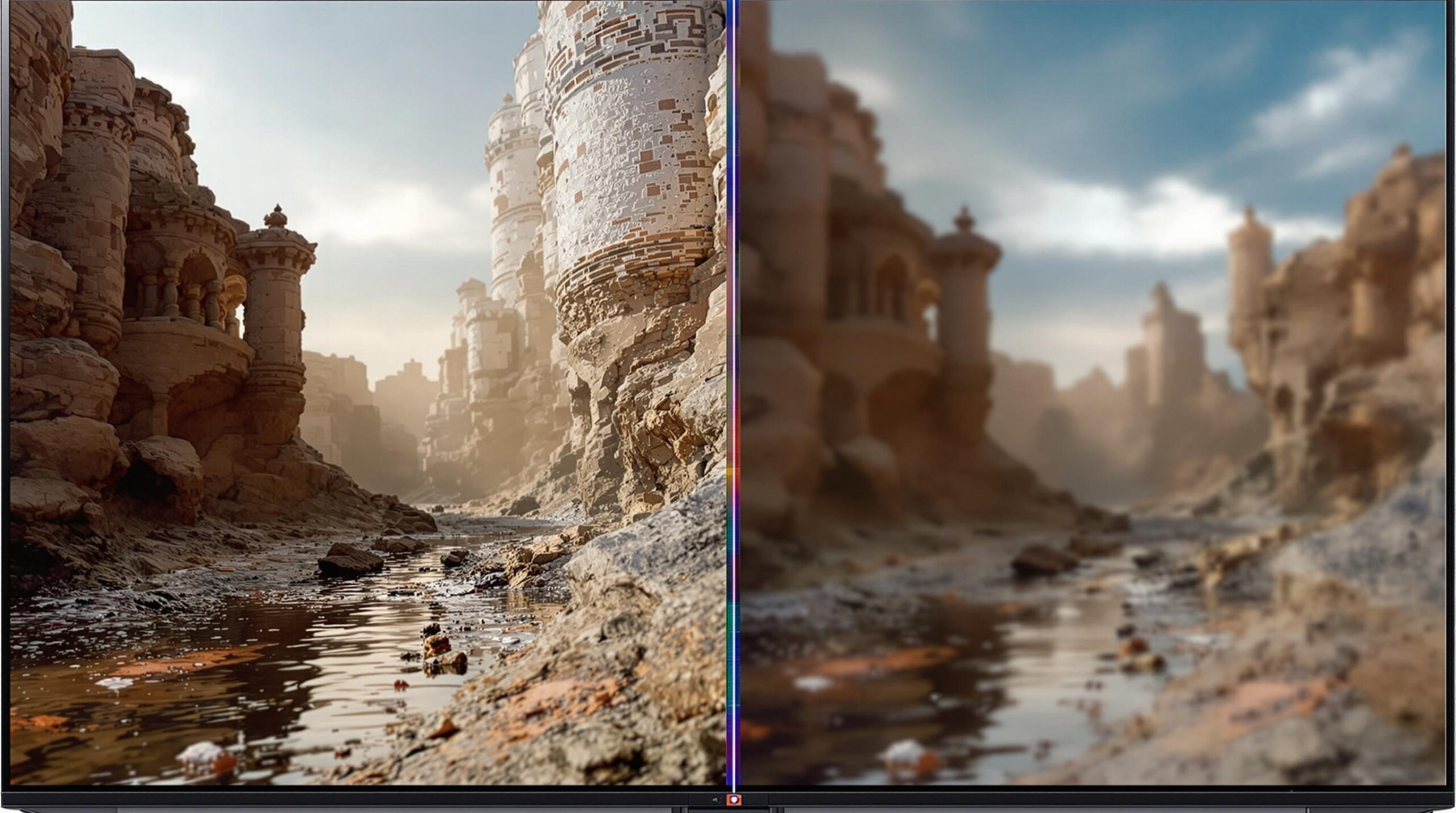
4K upscaling is the process of converting lower-resolution video signals (such as 720p or 1080p) into a 4K format so they can fill all 3,840 x 2,160 pixels on a UHD TV screen. Upscaling is not the same as native 4K. Rather than adding real detail, upscaling algorithms predict what those extra pixels should look like based on mathematical models, pattern recognition, and contextual image data.
Modern OLED TVs use powerful video processors to execute upscaling in real time. These chips analyze the incoming signal, detect edges, textures, and color gradients, and interpolate new pixel values to fill in the resolution gap. High-end upscaling systems, often branded with names like “AI Upscaling” or “Deep Learning Super Resolution,” use trained neural networks to make these predictions more intelligent, even reconstructing fine details like hair strands or building textures from low-resolution input.
Pixel Density and the Illusion of Detail
From a physics standpoint, the ability to perceive more detail in an upscaled image depends heavily on pixel density and viewing distance. A 65-inch OLED TV viewed from 8 to 10 feet away typically reaches the limits of human visual acuity. At that distance, the eye can’t distinguish individual pixels in native 4K, let alone discern whether an image was originally upscaled.
This physiological limit is what makes upscaling viable. By filling the screen with estimated detail that the eye cannot easily distinguish from true 4K, upscaling creates the illusion of native resolution. The underlying physics of light emission from OLED pixels—combined with the uniformity and precision of self-emissive subpixels—further enhances this illusion by maintaining edge sharpness and color purity.
OLED’s superior black levels and contrast ratios also contribute to the perception of detail, even if the original resolution was lower. When dark and bright areas are well-defined, the brain interprets the image as being more detailed and lifelike than it actually is.
How Upscaling Works: Interpolation and Beyond
The core of 4K upscaling lies in interpolation—the mathematical estimation of intermediate pixel values. The simplest form is bilinear or bicubic interpolation, where new pixels are created by averaging the values of neighboring pixels. This technique works reasonably well but often produces a soft or slightly blurry image.
Modern OLED TVs use more advanced methods like edge-adaptive interpolation and object-based scaling. These approaches analyze image contours and isolate objects within a frame—like faces, foliage, or text—before applying different scaling strategies to each. Edges are preserved, textures are refined, and noise is reduced.
More recent advancements leverage machine learning. Upscaling algorithms are trained on large datasets of low-res and high-res image pairs, learning how to infer missing detail more accurately. When deployed on-chip inside OLED TVs, these AI models can perform billions of calculations per second, reconstructing plausible details with remarkable accuracy—especially on OLED screens that reveal even minute imperfections due to their pixel-level clarity.
The Chemistry of OLED and Its Role in Image Quality
The upscaling process becomes even more effective when paired with the precise light control of OLED pixels. OLED displays use organic compounds that emit light when electrically stimulated. Each subpixel (red, green, blue, and sometimes white) is composed of carefully engineered carbon-based molecules designed to emit narrow-bandwidth light, providing vivid color and high efficiency.
This self-emissive property allows OLED panels to render each newly interpolated pixel with absolute independence—no backlight bleed, no pixel leakage. As a result, the upscaled image appears crisp and coherent. Because the light output of each pixel is precisely controllable, gradients are smoother, edges are cleaner, and the upscaled content retains a high degree of realism.
Additionally, OLED panels exhibit near-instantaneous response times due to the fast-switching nature of their emissive layers. This ensures that even dynamically upscaled content—such as 1080p sports broadcasts or HD gaming—remains smooth and ghost-free during fast motion, further improving perceived sharpness.
Upscaling and Signal Processing Architecture
Behind the scenes, upscaling involves complex signal processing pipelines embedded in the TV’s system-on-chip (SoC). These pipelines consist of dedicated logic blocks for noise reduction, deinterlacing, color remapping, contrast enhancement, and dynamic sharpening.
For OLED displays, upscaling engines must be particularly robust because OLED’s high contrast and pixel fidelity expose visual artifacts more easily. A weak upscaling processor will result in ringing (bright halos around objects), banding (visible color steps), or temporal artifacts during motion sequences.
High-end OLEDs from brands like LG, Sony, and Panasonic often use multi-pass upscaling. This involves applying initial interpolation to boost resolution, followed by edge refinement, temporal smoothing (to avoid flicker), and AI-based fine tuning of detail zones like eyes, skin texture, or small text.
Moreover, modern processors are capable of adjusting the upscaling strategy based on the content type—movies, sports, animation, or news—dynamically selecting algorithms that optimize clarity and smoothness based on frame complexity and movement analysis.
The Engineering Behind OLED Pixel Precision
Each OLED pixel is driven by thin-film transistors (TFTs) embedded within the display’s active matrix. These transistors modulate the voltage and current supplied to the emissive organic layers. For upscaling to work flawlessly, these pixel drivers must respond accurately to the high-frequency signal output from the TV’s processor.
The key engineering challenge here is maintaining uniformity and response speed across millions of pixels. If the transistors fail to regulate voltage evenly, newly interpolated pixels may show inconsistent brightness or color—something that becomes glaringly obvious in darker scenes. High-quality OLED panels undergo rigorous compensation mapping during production, correcting for slight variances in subpixel performance to ensure each pixel contributes equally to the upscaled image.
In addition, heat dissipation engineering is critical. Upscaling increases computational demand and frame generation rate, producing thermal energy that must be managed. Manufacturers use graphite sheets, aluminum backplates, and thermal sensors to maintain panel temperature within safe limits—especially vital when running AI-driven upscaling continuously.
How Good Is 4K Upscaling Really?
The effectiveness of 4K upscaling depends on several factors: the quality of the source content, the power of the upscaling engine, and the capabilities of the display technology. When low-resolution video is clean and free of compression artifacts, upscaling can dramatically enhance clarity. However, if the source is riddled with noise, low bitrates, or poor encoding, no amount of upscaling can fully reconstruct lost detail.
On an OLED TV, good upscaling can look remarkably close to native 4K—especially at normal viewing distances. Modern upscaling engines can sharpen fine lines, reduce blockiness, and enhance perceived texture without introducing obvious artifacts. While it’s not a replacement for true 4K content, it significantly enhances the viewing experience of legacy HD material.
Moreover, OLED’s deep blacks and precise highlight rendering create contrast cues that our brains interpret as increased sharpness. This psychological effect makes upscaled 1080p on OLED appear much more detailed than it would on a conventional LCD screen.
Real-World Scenarios: Movies, Streaming, and Gaming
In real-world use, upscaling proves most useful in streaming and broadcast scenarios. Services like Netflix, Amazon Prime, and YouTube offer 1080p and 720p content that can be upscaled to near-4K quality on OLED TVs. Sports broadcasts and news channels—which are often limited to 720p or 1080i—also benefit, especially when viewed on large panels.
Gaming consoles such as the PlayStation 4 or Xbox One output 1080p, but OLED TVs upscale these signals fluidly, preserving color accuracy and sharpness. Some newer consoles like the PS5 and Xbox Series X use built-in game upscaling engines, which, when combined with the TV’s own upscaler, produce nearly indistinguishable results from native 4K—especially in fast-paced environments where motion clarity and input response matter most.
Animated content, with its hard lines and bold colors, also upscales very well. OLED panels display the clean edges and flat shading of animation with almost no visible artifacts, even when the source resolution is sub-4K.
The Limits of Upscaling: Knowing When It Breaks Down
While upscaling has come a long way, it is not magic. When source material is heavily compressed, poorly encoded, or interlaced, upscaling can only go so far. In these cases, upscaling may exaggerate compression blocks or introduce shimmering effects. Additionally, content that relies on fine textural detail—like documentary nature footage—will always benefit from true 4K masters over upscaled versions.
From an engineering standpoint, these limitations stem from the fact that interpolation, even when AI-assisted, cannot recreate information that was never there. The OLED panel may render the enhanced frame perfectly, but it is still based on best-guess predictions rather than native pixel data.
Conclusion: Upscaling, OLED, and the Pursuit of Perfection
4K upscaling is a cornerstone of the modern TV experience, enabling viewers to enjoy older or lower-resolution content in a way that complements today’s ultra-sharp displays. While upscaling cannot match the authenticity of native 4K, the combination of advanced processing, deep learning algorithms, and OLED panel technology brings it impressively close.
Through precision pixel control, chemically engineered light emission, and lightning-fast response times, OLED displays give upscaled content an ideal canvas. Whether you’re streaming HD movies, watching live sports, or gaming on legacy consoles, a well-engineered OLED TV makes the most of every pixel—even the ones your content didn’t originally have.
In a world where content formats lag behind display hardware, 4K upscaling is not just a convenience—it’s a necessity. And when implemented correctly, it transforms “good enough” into something truly extraordinary.
4K TV Reviews
Explore Philo Street’s Top 10 Best 4K TV Reviews! Dive into our comprehensive analysis of the leading 4K TV products, complete with a detailed side-by-side comparison chart to help you choose the perfect protection for your devices.