
Why Mini-LED Is Changing the TV Game
In the ever-expanding universe of display technology, Mini-LED has emerged as a transformative innovation—one that bridges the performance gap between traditional LED-LCD panels and next-generation self-emissive technologies like OLED and MicroLED. Marketed for its enhanced brightness, contrast, and precision in light control, Mini-LED technology represents a significant evolution in backlighting architecture, pushing the limits of what’s possible within the LCD framework. While it might sound like just another version of LED, Mini-LED is fundamentally a leap forward in display engineering, offering many of the visual benefits of OLED without some of its technical drawbacks.
This comprehensive article explores the physics, chemistry, and engineering principles behind Mini-LEDs. From photon generation to light management and pixel-level control, we’ll demystify what makes Mini-LED so revolutionary—and why it’s set to dominate premium displays for years to come.
What Is Mini-LED? A Refined Form of LED Backlighting
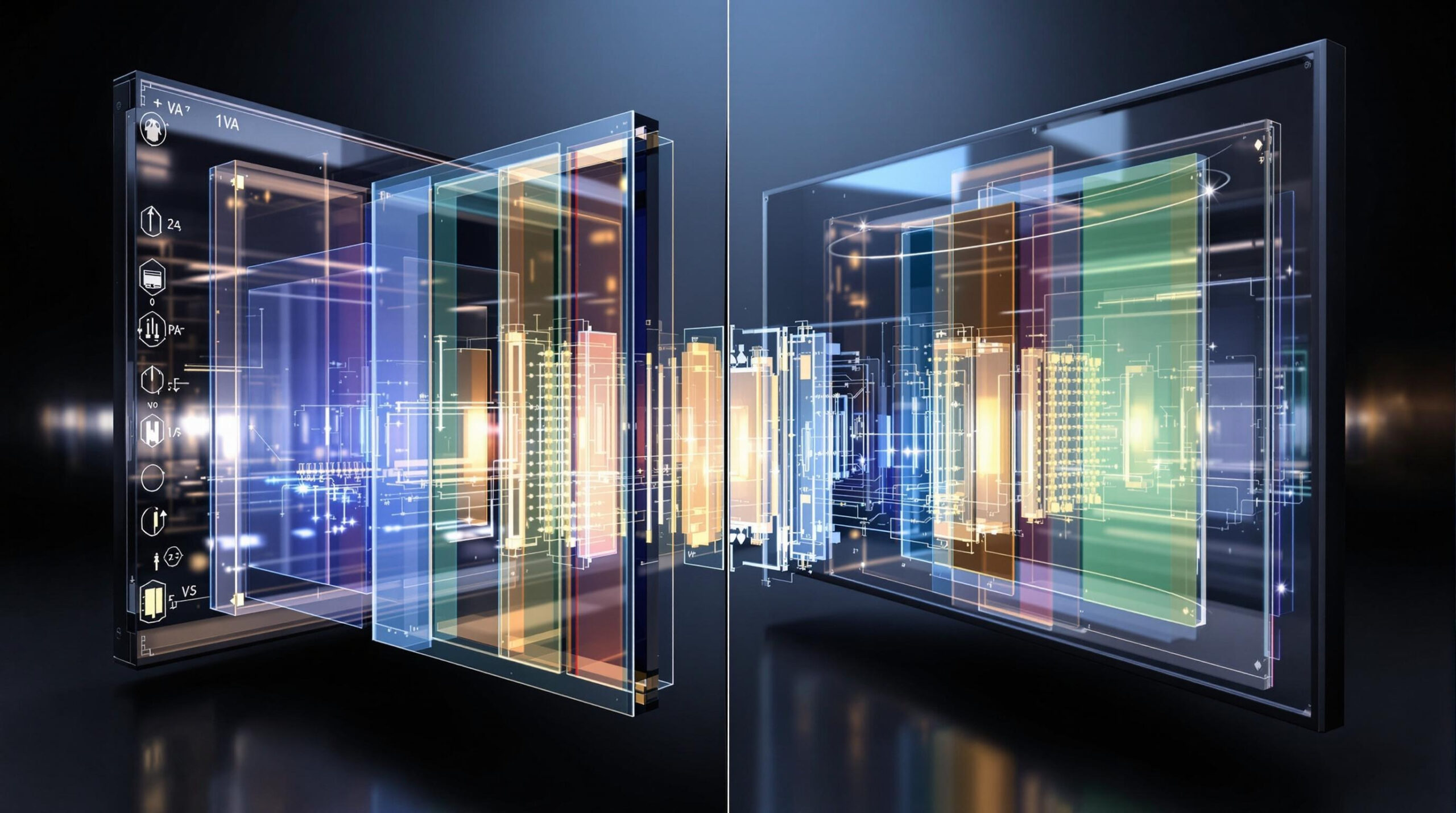
Mini-LED is a type of backlight technology used in LCD (Liquid Crystal Display) TVs. Unlike OLED or MicroLED—which are self-emissive technologies, where each pixel generates its own light—Mini-LED continues to rely on the traditional LCD structure but vastly improves the backlighting system.
The key difference lies in scale and precision. Standard LED TVs use relatively large light-emitting diodes for their backlight, often organized into a limited number of zones (e.g., 16, 32, or 100 zones). Mini-LED shrinks the size of these LEDs dramatically—down to around 100–300 microns, roughly 1/40th the size of traditional LEDs. Because they’re smaller, thousands more can be fitted behind the screen, enabling finer local dimming zones—sometimes exceeding 1,000 or even 5,000 zones.
This results in more precise control over brightness and darkness across the display, dramatically improving contrast, HDR performance, and black-level uniformity without the drawbacks of OLED’s organic material degradation.
The Physics of Light Emission in Mini-LEDs
At the core of Mini-LED technology lies the same basic electroluminescence principle as in standard LEDs. When voltage is applied across a semiconductor junction, electrons from the n-type region and holes from the p-type region recombine at the junction. This electron-hole recombination releases energy in the form of a photon, creating visible light.
Mini-LEDs use a highly refined gallium nitride (GaN) or indium gallium nitride (InGaN) semiconductor as their light source, which allows for efficient and high-intensity blue light emission. Blue is the preferred starting point because it can be converted into white light using phosphor coatings, or used in RGB arrays to generate the full color spectrum.
The reduction in LED size doesn’t change the fundamental physics, but it concentrates and localizes light emission. Since Mini-LEDs can be densely packed and precisely controlled, they create a tighter beam angle and significantly reduce unwanted light leakage—a critical advantage in maintaining high contrast ratios and minimizing blooming.
Miniaturization Through Material Science and Engineering
Shrinking an LED to microscopic dimensions is not as simple as scaling down a light bulb. Mini-LEDs must maintain thermal stability, electrical efficiency, and long-term reliability despite their reduced footprint. Achieving this requires innovations in materials science, epitaxial growth, and photonic engineering.
The semiconductor wafer is grown using metal-organic chemical vapor deposition (MOCVD), where gases containing gallium, nitrogen, and other elements are precisely layered at an atomic level onto a sapphire or silicon carbide substrate. Once the GaN layers are established, the wafer is patterned and etched using photolithography to define individual emitters. Each emitter must then be precisely diced, packaged, and mounted using flip-chip bonding—a method that allows direct connection between the LED and the circuit board, minimizing resistance and improving heat dissipation.
To ensure uniform brightness across the entire panel, Mini-LEDs are bin sorted according to their optical output, wavelength, and forward voltage, guaranteeing color and brightness consistency across thousands of diodes.
Thermal Management: The Key to Performance Longevity
Miniaturization brings not only efficiency but also thermal challenges. When LEDs are packed closely together and driven at high brightness, thermal buildup can degrade performance, shorten lifespan, and cause uneven illumination. Advanced Mini-LED displays use thermally conductive substrates like aluminum nitride or ceramics, as well as copper heat sinks and graphene-enhanced thermal interface materials, to draw heat away quickly and evenly.
In some high-performance implementations, active cooling systems, such as thin vapor chambers or miniature fans, are used to maintain optimal operating temperatures, particularly in ultra-thin panels or high-brightness professional displays.
Effective heat management ensures not only brightness stability but also prevents thermal cross-talk between adjacent LEDs—critical for maintaining the integrity of fine local dimming zones.
Local Dimming: Precision in Light Control
Mini-LED’s true strength lies in its ability to create hundreds to thousands of independently controlled backlight zones. Each of these zones can adjust its brightness in real-time based on scene-by-scene and frame-by-frame image analysis. This technique is known as Full-Array Local Dimming (FALD), and with Mini-LED, it becomes ultra-fine local dimming.
This precision is crucial for displaying High Dynamic Range (HDR) content. In a night scene with bright stars in a dark sky, for example, only the zones behind the stars need to be brightened, while the surrounding zones remain dim or completely dark. The more dimming zones available, the closer the display comes to true pixel-level control, approaching the performance of OLED without its burn-in risks.
Advanced algorithms analyze incoming video signals and adjust each zone’s brightness in real-time, guided by local dimming maps and tone mapping curves optimized for HDR10, Dolby Vision, and HLG content formats.
Color Reproduction: Partnering with Quantum Dots
While Mini-LED enhances backlighting, it still requires a color-filtering mechanism to create the full range of visible hues. This is where Mini-LED technology often partners with Quantum Dot (QD) layers, creating Mini-LED QLED displays. These displays use a blue Mini-LED backlight to excite quantum dots that emit precise red and green wavelengths, while the remaining blue light passes through as is.
Quantum dots are nanocrystals that emit light based on their size—a principle derived from quantum confinement. Their narrow-band emission results in extremely pure, saturated colors, significantly increasing the display’s color volume, especially at higher brightness levels.
The result is a display capable of reproducing over 100% of the DCI-P3 color space, maintaining vivid color fidelity even in well-lit rooms or under direct sunlight. This combination makes Mini-LED with quantum dots a serious contender in color-critical environments like professional editing suites and gaming setups.
Contrast and Brightness: Defining Visual Dynamism
Mini-LED technology excels in dynamic range, the span between the darkest blacks and the brightest whites. With peak brightness often exceeding 1,500 to 2,000 nits, Mini-LED TVs can showcase HDR content as intended by filmmakers, revealing subtle highlights and shadow details that are otherwise lost in standard displays.
Although not self-emissive like OLED, Mini-LED approaches OLED-like contrast ratios through sheer backlight precision. Blooming, a common issue where bright areas bleed into adjacent dark zones, is minimized due to smaller LED sizes and more sophisticated dimming zones. High-end models also use black matrix layers—light-absorbing films placed between zones—to further suppress stray light.
Because Mini-LED backlights can be driven to extremely high brightness without causing pixel-level degradation, they’re ideal for HDR mastering, sports viewing, and gaming, where peak brightness and fast response times matter most.
Durability and Lifespan: An Inorganic Advantage
One of the most compelling advantages of Mini-LED over OLED is its durability. OLED panels use organic compounds that degrade over time, especially blue emitters. This results in burn-in risks and diminished brightness after prolonged use. In contrast, Mini-LED uses inorganic semiconductors that are significantly more stable.
As long as thermal conditions are well-managed, Mini-LED backlights can deliver tens of thousands of hours of consistent luminance without any permanent image retention. This makes Mini-LED displays ideal for applications where screens are left on for long periods, such as in signage, broadcast studios, or control rooms.
Additionally, Mini-LED panels are generally less fragile during manufacturing and handling, reducing cost in the supply chain and improving yield rates during production.
Challenges and Engineering Solutions
Despite its many benefits, Mini-LED is not without its engineering challenges. Precision alignment of thousands of LEDs requires high-accuracy pick-and-place robotics and advanced die bonding techniques. If even a single Mini-LED is misplaced or defective, it could create hot spots, dead zones, or color inaccuracies.
To solve this, manufacturers implement automated optical inspection (AOI) systems during production to identify irregularities. Redundancy circuits are also embedded to reroute current in case of individual LED failure.
Another hurdle is cost. Producing and calibrating thousands of tiny LEDs adds complexity and increases material costs. However, as fabrication tools improve and mass production scales up, economies of scale are bringing Mini-LED closer to mainstream affordability.
Mini-LED vs. OLED vs. MicroLED: How They Compare
While OLED offers perfect blacks and pixel-level light control, it falls short in brightness, longevity, and risk of burn-in. MicroLED promises the best of both worlds—self-emissive pixels made of inorganic LEDs—but remains prohibitively expensive and difficult to scale to consumer-level sizes.
Mini-LED hits the sweet spot: a mature, scalable, and reliable technology that brings OLED-like contrast with higher brightness and better durability. It’s also more adaptable to a range of screen sizes, from compact monitors to ultra-large TVs and public displays.
High-end Mini-LED models now rival or exceed OLED in real-world viewing scenarios—especially in brightly lit rooms—and often do so at a lower long-term ownership cost.
Future Outlook: What’s Next for Mini-LED?
Mini-LED is still evolving. Next-generation panels are exploring Micro Lens Arrays (MLA) to boost light transmission efficiency. Engineers are working on Active Matrix Mini-LED backplanes, where each LED is individually addressable through a thin-film transistor (TFT) array—enabling even finer light control approaching true emissive performance.
Other developments include Mini-LED-on-glass substrates for ultra-thin, rigid panels, and flexible Mini-LED arrays for curved or rollable displays. Combined with AI-powered dimming algorithms, future Mini-LED displays will push precision, brightness, and realism to unprecedented levels.
Moreover, ongoing research aims to make Mini-LED fabrication more eco-friendly, exploring lead-free soldering, recyclable components, and sustainable energy use during production.
Conclusion: The Bright Future of Mini-LED
Mini-LED is not just a stopgap between LCD and next-gen tech—it’s a meaningful and lasting innovation built on solid science and advanced engineering. By miniaturizing the LED backlight, improving local dimming, enhancing color accuracy, and delivering OLED-like contrast with superior brightness and reliability, Mini-LED represents a massive leap forward in how we perceive visual content.
Its strength lies in its scalability, versatility, and performance, making it a perfect fit for everything from cinematic home theaters and gaming rigs to commercial signage and professional displays.
As the technology continues to mature, Mini-LED will become even more refined, more affordable, and more powerful—redefining what consumers can expect from premium display systems. Whether you’re watching a movie in HDR10+, designing digital content, or competing in a high-stakes eSports tournament, Mini-LED is ready to light the way.
LED/LCD TV Reviews
Explore Philo Street’s Top 10 Best LED/LCD TV Reviews! Dive into our comprehensive analysis of the leading LED/LCD TV products, complete with a detailed side-by-side comparison chart to help you choose the perfect protection for your devices.