
OLED’s Enduring Allure
In the ever-evolving world of television technology, few acronyms carry the same weight as OLED. Short for Organic Light-Emitting Diode, OLED has consistently set the gold standard for picture quality, color fidelity, contrast ratio, and design flexibility. While competing technologies like QLED, Mini-LED, and Micro-LED continue to make noise, OLED remains the benchmark against which all others are measured. But what makes OLED so fundamentally superior? To answer that, we must dive into the scientific and engineering principles that power this remarkable display technology, layer by layer, molecule by molecule.
This article unpacks the physics, chemistry, and engineering behind OLED displays in a way that’s rich in detail yet accessible. From the molecular properties of organic compounds to the architectural layout of OLED panels and their electrical behavior, we’ll explore why OLED remains unrivaled in delivering pure blacks, infinite contrast, and incredible color performance.
The Foundation: What Is OLED, Really?
At its core, OLED stands for Organic Light-Emitting Diode. Unlike traditional LCDs, which require a separate backlight to illuminate pixels, OLED panels are self-emissive—each pixel generates its own light. This results in true blacks and extraordinary contrast because a pixel can be completely turned off, producing zero light output.
The structure of an OLED is made up of several ultra-thin organic layers sandwiched between electrodes. These layers include an emissive layer, which is where the light is actually produced, and a conductive layer, which helps move electrical charges to the emissive layer. The materials used are organic because they contain carbon-based molecules, not because they are “natural” or biodegradable.
When a voltage is applied across the OLED stack, electrons and holes (positively charged carriers) are injected from opposite electrodes. These particles meet in the emissive layer and recombine to release energy in the form of light—a process known as electroluminescence.
A Closer Look: The Physics of Electroluminescence
The key mechanism behind OLED technology is electroluminescence, a quantum phenomenon whereby electrons emit photons when they transition from a higher-energy state to a lower one. Here’s what happens on a physical level:
An OLED display contains multiple organic thin films—each only a few hundred nanometers thick. When an electrical current passes through these layers, electrons (negative charge carriers) flow from the cathode, while holes (positive charge carriers) flow from the anode. In the emissive layer, electrons and holes meet and recombine.
This recombination releases energy in the form of photons. The wavelength—or color—of the emitted light depends on the specific molecular structure of the emissive material. By carefully engineering these molecules, manufacturers can control the color output with extreme precision, enabling vibrant reds, blues, and greens.
Molecular Design: The Chemistry Behind OLED
OLED chemistry is where science meets art. The organic compounds used must be carefully synthesized to optimize light output, color purity, thermal stability, and efficiency. Typically, OLED materials fall into two main classes: small-molecule OLEDs and polymer OLEDs (PLEDs).
Small-molecule OLEDs offer better control and efficiency and are used in high-end TVs, while PLEDs are generally cheaper and easier to process. Regardless of the class, each emissive material contains π-conjugated systems, where electrons are delocalized across multiple atomic bonds. These systems are ideal for absorbing and emitting visible light.
One of the biggest innovations in OLED chemistry has been the development of phosphorescent OLEDs (PHOLEDs). Unlike traditional fluorescent OLEDs, which convert only about 25% of electrical energy into light, PHOLEDs use heavy metal atoms like iridium to harvest both singlet and triplet excitons—allowing up to 100% internal quantum efficiency.
Engineering the Stack: How OLED Panels Are Built
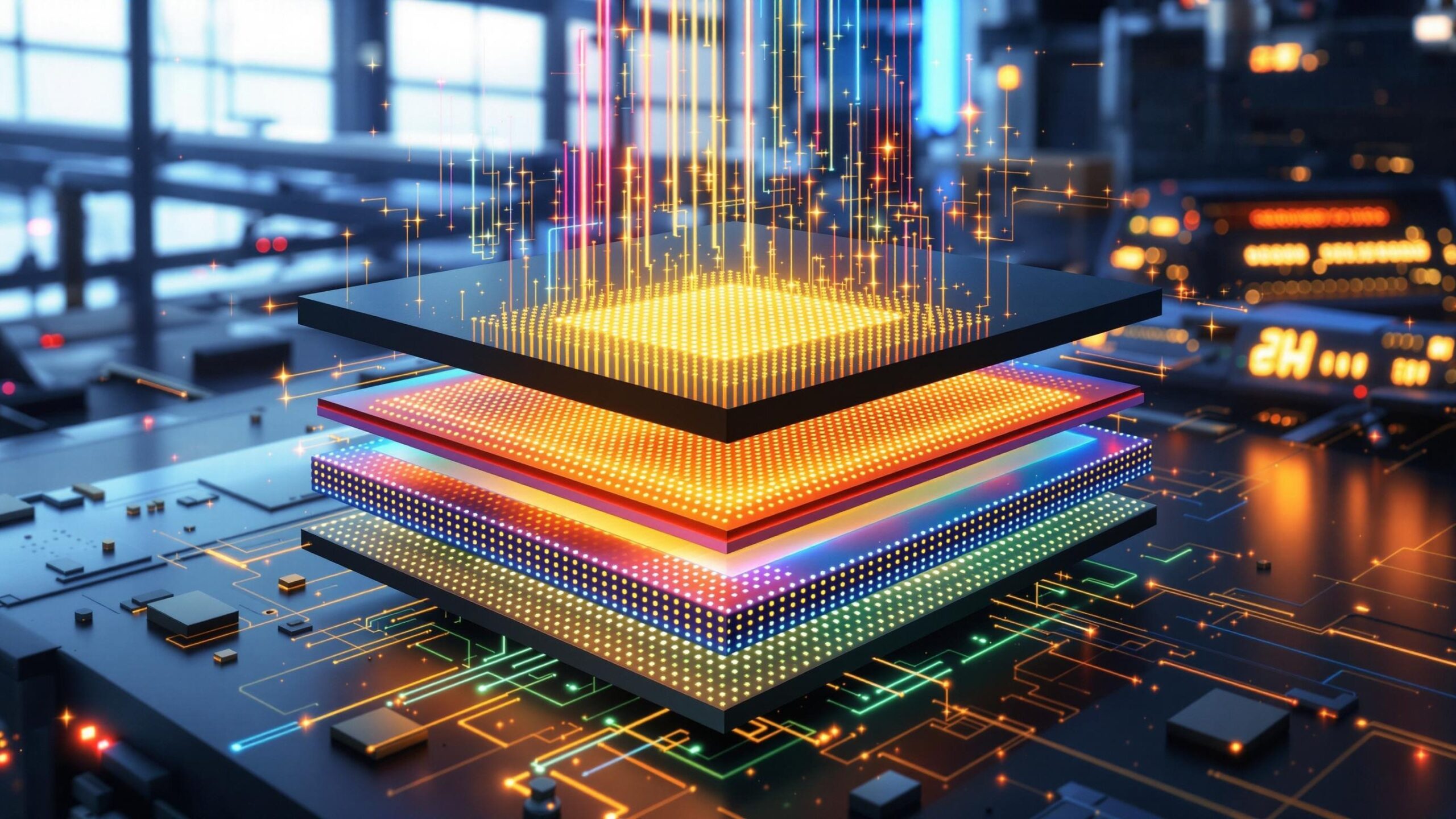
The architectural design of an OLED panel is a marvel of nano-engineering. A standard OLED stack typically includes the following layers (from bottom to top):
Substrate – Usually glass or flexible plastic.
Anode – Transparent, often made of Indium Tin Oxide (ITO), to allow light emission.
Hole Injection Layer (HIL) – Improves hole transport into the organic layers.
Hole Transport Layer (HTL) – Moves holes efficiently to the emissive layer.
Emissive Layer (EML) – Where electroluminescence occurs.
Electron Transport Layer (ETL) – Facilitates movement of electrons.
Electron Injection Layer (EIL) – Aids in injecting electrons from the cathode.
Cathode – Often a reflective metal like aluminum.
Each of these layers is just a few nanometers thick and must be applied with atomic precision. Modern manufacturing often uses vacuum thermal evaporation (VTE) to deposit layers under high vacuum, though inkjet printing and organic vapor phase deposition (OVPD) are gaining traction.
Color Reproduction: Sub-Pixel Magic
OLED TVs achieve full-color output through one of two methods: RGB OLED or White OLED with color filters (WOLED).
RGB OLED uses individual red, green, and blue sub-pixels to create color, but this approach has manufacturing challenges and lower lifespan for blue emitters. Instead, most commercial OLED TVs—especially those made by LG—use WOLED technology, where a white light is generated and passed through red, green, and blue color filters to produce the final image.
The benefit of WOLED is longevity and uniformity, but it can come at the cost of peak brightness. To compensate, manufacturers use color-boosting layers, microlens arrays, and compensation algorithms to optimize luminance and maintain color accuracy.
Black Levels and Infinite Contrast: OLED’s Signature Strength
One of OLED’s most lauded features is its ability to produce absolute black. Since each pixel emits its own light, turning off a pixel produces no light at all. In contrast, LCD-based displays require a backlight, which leaks some light even in dark areas, resulting in “black” that’s actually gray.
This self-emissive property gives OLED its infinite contrast ratio—the ratio of the brightest white to the darkest black. No matter how advanced LCDs become, with local dimming zones and better backlights, they cannot match OLED’s pixel-level precision.
In practical terms, this means OLED is unparalleled in dark room performance. Shadow details are crisp, colors remain accurate in low light, and scenes with high dynamic range (HDR) look breathtaking.
Response Time and Motion Clarity: Faster Than the Eye
Another area where OLED excels is response time—the speed at which a pixel can change from one state to another. OLED pixels transition in microseconds, compared to milliseconds for most LCD pixels. This ultra-fast switching virtually eliminates motion blur, a common problem in fast-paced sports and action scenes on LCDs.
Because of this speed, OLED TVs don’t require tricks like black frame insertion or backlight scanning to reduce blur, which can often introduce flicker or reduce brightness on other TVs.
Gamers also benefit from this responsiveness. With support for variable refresh rates (VRR) and low input lag, OLED TVs are increasingly considered ideal for next-gen gaming experiences.
Viewing Angles and Color Uniformity
OLED panels offer exceptional viewing angles because their self-emissive nature ensures consistent light output across all directions. There’s no color or brightness shift when viewing the screen from the side, which is a common limitation in LED-based TVs due to the directional nature of LED backlighting and the use of polarizers.
Uniformity is also superior. Since each pixel emits its own light, the brightness and color remain consistent across the screen, free from the dirty screen effect or clouding often seen on LCDs with uneven backlighting.
Lifespan and Burn-In: The Persistent Trade-Off
No technology is perfect, and for OLED, the primary concerns are burn-in and lifetime degradation. Burn-in occurs when static images, like logos or news tickers, cause uneven wear on OLED pixels. This results from differential aging, where certain sub-pixels degrade faster than others—especially the blue ones, which are less stable.
However, modern OLED TVs use pixel shift, logo luminance reduction, and panel refresh algorithms to mitigate these effects. Real-world testing shows that under typical use, burn-in is unlikely unless static content is displayed excessively over thousands of hours.
As for lifespan, recent advancements in blue emitter stability and compensation layers have extended panel longevity well beyond 30,000–50,000 hours—enough for a decade or more of daily use.
OLED vs the Competition: QLED, Mini-LED, and MicroLED
OLED is often pitted against QLED, Mini-LED, and the emerging MicroLED. While QLEDs use quantum dots to improve color in LCDs, they still rely on backlights, limiting black levels and viewing angles. Mini-LED improves local dimming granularity, but again, it cannot achieve true blacks.
MicroLED is the most promising challenger. Like OLED, it’s self-emissive, but uses inorganic LEDs for each pixel, offering higher brightness and no burn-in risk. However, MicroLED remains prohibitively expensive and difficult to scale down for home use.
In today’s market, OLED remains the only mature self-emissive technology offering a blend of price, performance, and availability that makes it a top-tier choice for home theaters.
Future Innovations: What’s Next for OLED?
The OLED landscape continues to evolve. Inkjet printing of OLED panels promises lower production costs and new form factors. Tandem OLED structures, which layer multiple emissive stacks, are increasing brightness and lifespan. Hybrid QD-OLED panels, pioneered by Samsung, combine OLED with quantum dots for improved color and brightness.
Flexible OLED displays have already revolutionized the smartphone market and may soon lead to rollable and foldable TVs that redefine form factor entirely.
Additionally, research into TADF (Thermally Activated Delayed Fluorescence) materials could create 100% efficient blue emitters without using rare-earth metals, reducing cost and increasing environmental sustainability.
Conclusion: The OLED Legacy Is Just Beginning
OLED is far more than a flashy acronym—it’s a convergence of physics, chemistry, and electrical engineering, manifesting in a technology that continues to shape the future of visual storytelling. From its perfect black levels and infinite contrast to unmatched response time and color accuracy, OLED has earned its reputation as the gold standard in TV displays.
While other technologies may offer improvements in brightness or price, none have yet dethroned OLED’s combination of aesthetic beauty, technical precision, and immersive capability. And with continued innovation driving OLED into new form factors and performance tiers, its reign as the king of displays is far from over.
For anyone seeking the ultimate television experience—one rooted in science and executed with art—OLED still delivers the clearest, most vibrant window into the digital world.
OLED TV Reviews
Explore Philo Street’s Top 10 Best OLED TV Reviews! Dive into our comprehensive analysis of the leading OLED TV products, complete with a detailed side-by-side comparison chart to help you choose the perfect protection for your devices.